Winfield Scott Quotes
The men under General [Zachery] Taylor’s command committed crimes that would make Heaven weep.
See {637209} for an example. There was no government policy to commit war crimes nor was there any suggestion from the military command. Most of the worst cases were volunteer militia groups from the same geographic area. The political propaganda from President Polk, an inveterate racist, and other government and Congressional leaders created a classic atmosphere where soldiers get out of control. Specifically, that the enemy is a lesser human being not deserving the full rights and sympathies of a white man.
Winfield Scott, 1786-1866, Commanding General, U. S. Army, Letter to the Secretary of War, 1847
Sourced by: Eigen's Political and Historical Quotations

See {637208} and {637209} for examples of some of the excesses.

Yuliy Osipovich Martov. Criticism of the Bolshevik behavior in dealing with counter-revolutionaries in the civil war that followed the Russian Revolution. This despite the fact that the death penalty had been abolished right after the Revolution. See {590510}

Turkey, under the control of the triumvirate of the 3 Young Turks had massacred almost all of the Armenian population in the area claimed by Turkey. At the end of WWI, there were many demands that those who ordered the policy of a Turkish genocide and those who carried it out by brought to justice—tried and punished. The Sultan had done little if anything to stop the slaughters although he was very weak, Turkey under the Young Turks had also picked the wrong side and allied with the Germans. The Sultan and his Grand Vizier were trying to pick up the pieces and maintain the Ottoman Empire as best they could despite they the fact that they lost control of much of their vast territory. At the Paris Peace Conference, the Grand Vizier virtually admitted the crimes and committed the Turkish government to determining the guilty and bringing them to justice. He actually had 50 of the worst offenders arrested (See {620595}.). However, there were a few tried and one governor of a province was hanged and a few others received short jail sentences. Talaat, the worst of The Young Turks regarding the genocide, escaped to Germany. But he was tracked by a surviving Armenian who assassinated Talaat. The assassin was acquitted by a sympathetic German court which ruled that the extermination of the assassin’s family had been so traumatic that temporary insanity relieved the assassin of criminal responsibility.

Lawrence of Arabia. In the Middle East, Lawrence led a small Arab army against the Turks and the Germans. In a battle near Tafas, the captured 250 Turkish and German soldiers as prisoners. They them shot them all in cold blood with their Hotchkiss machine gun. What makes this quotation so significant is that one of the great British heroes of WWI was actually guilty of War Crimes. An American journalist gave Lawrence and his exploits great publicity without mentioning the atrocities. The British chain of command also ignored the transgression of one of the most fundamental rules of war even though the clear evidence was in basic battle report files. However, the British never removed the report from the files or destroyed it. The Turks and the Germans while they respected the rules of war with the English, French, and most allies, treated the Arabs much more harshly and murdered Arab prisoners on many occasions. In part this atrocity at Tafas was an act of vengeance and retaliation. But Lawrence never even tried to explain it.
The White Boers viewed themselves as superior to the Blacks and the Blacks and Whites competed for land. In an early form of ethnic cleansing, the Boers attacked the undefended women and children of the Black tribes. The authorities opposed these atrocities but did not have any way of enforcing their orders.

There is disagreement amongst historians as to whether or not the atrocities attributed to the retreating British troops were actually true. There are two other possibilities. First, this report was made only a week after the battle itself and less than that since the alleged atrocities would take place as the British retreated. There were certainly all kinds of rumors with information passed from person to person with no modern means of documentation. The Provisional Congress may have sincerely thought that all the events occurred but they may have been the result of inadvertent exaggeration. Then there is the possibility that in order to fire up the Americans to join the war, some or all of the atrocity reports were deliberately fabricated. It would only take two or three delegates to agree on such a strategy and they could “confirm” each other’s accounts of the happenings. Of course it might all be true. However, as the British retreated to Boston where they had reinforcements, they did not have a lot of time for malicious atrocities. All along the route, Minutemen, local farmers and townspeople continued the attack against the British. By the time the British soldiers reached Boston, 73 British solders were dead and 174 more were wounded. In war truth does not have the respect that it usually does. See {626632}.


The soldiers obeyed their orders and killed every man, woman and child they could find outside the city. They beheaded captured prisoners, bayoneted pregnant women and children. All civilian houses were burned, often with the people trapped inside.
Referring to the behavior of English King Edward I, 1239-1307, towards Scotland:
The U.S. was at war with Spain and Filipino insurgents for the control of the Philippines. During this war there were a few senior U. S. Officers who in later times would have been tried and jailed for war crimes. The men under them were brutal and committed atrocities at their orders. See {615368}.

This statement caused great consternation. NcNutt did try to explain that he was speaking personally and not for the Government, but there was a small proportion of America who had concluded that all Japanese should be killed. Such an concept which was unthinkable 5 years earlier was considered as a result of several factors: The Japanese had murdered many American prisoners of war. Killed millions of civilians throughout Asia including doing medical and weapons experiments on live human beings. They had practiced torture, compulsory prostitution and mass rape of conquered territories. At the same time, the Germans had tried to exterminate all the Jews and, with some Japanese help, did kill two-thirds. The concept of genocide had been introduced to Americans as the concentration camps were liberated. And American casualties in the Pacific had been heavy. Vengeance was desired by many. Fortunately, the overwhelming majority of Americans never considered genocide seriously.
Roger’s Rangers of the French & Indian War were the first using unconventional warfare and invented the “deep raid” when they went in stealth all the way to Quebec and defeated the Abnaki Indians in their home village rather than defend against the Indians’ French coordinated attacks on upper York State. Rogers was portrayed by Spencer Tracy in the film Northwest Passage depicting the raid. All the men were killed but the women and children were captured and released with the exception of 5 teenagers who the Rangers took with them. This was one of the first formal “Rules of War” in what was otherwise a viciously uncivilized war.

The Creeks—the Cherokee traditional rivals and enemies were under a different command but all the other Indians were under Stand Watie’s command. In this quotation, we see the negative reaction that many Southerners had toward Quantrill and his cutthroats. This quote and others show that the Quantrill atrocities were generally known throughout the South. The Confederate command structure however, did nothing to rein in Quantrill’s atrocities much less discipline him for his war crimes. It is not clear to whom Waite referred as “enemies”—the Union troops or the Creeks, their traditional enemies. The slavery issue of the Civil War divided more than the nation. The Cherokee’s were badly divided over social class, aristocracy, strategy in keeping their land and tribal sovereignty, and slavery. A number of the older families had Black slaves. Stand Waite was one of the old, traditional, Cherokee, families, who were not happy losing their traditional power and influence when Jon Ross was elected tribal leader. He and his majority faction would not support the South in the Civil War. Stand Waite did, and after Ross was murdered Waite became the Second Cherokee Tribal leader.

While there were atrocities committed by both sides in the Civil War, the proportion tended to be heavily weighted by Confederate perpetrations. The Confederate officers were not appointed by the command structure and under strict military discipline, but they were elected by the troops and could be so removed (except for the general officers who were appointed by the confederacy). Also, the confederate troops were not as well fed or supplied as the North and they had fewer resources with which to fulfill their obligations to prisoners. In a number of battles, ill-clothed soldiers stripped the Union dead, wounded and prisoners, often naked to use their shoes, blankets and clothing, Union prisoners of war were much more badly abused in the prisoners of war camps like Andersonville which were not under the command of Robert E. Lee.

This was part of the continual conflict between the Muslims and the Eastern Orthodox Christians. The Greeks ended up doubling their territory.


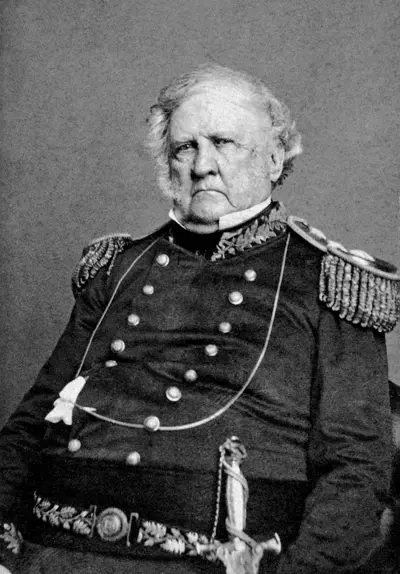
- Born: June 13, 1786
- Died: May 29, 1866
- Nationality:
- Profession:
Winfield Scott was an American military commander and political candidate. He served as a general in the United States Army from 1814 to 1861, taking part in the War of 1812, the Mexican–American War, the early stages of the American Civil War and conflicts with Native Americans. Scott was the Whig Party's presidential nominee in the 1852 election, but was defeated by Democrat Franklin Pierce. He was known as Old Fuss and Feathers for his insistence on proper military etiquette, as well as the Grand Old Man of the Army for his many years of service.
