J. William Fulbright Quotes
The junior Senator from Wisconsin, by his reckless charges, has so preyed upon the fears and hatred of uninformed and credulous people that he has started a prairie fire, which neither he nor anyone else may be able to control.
Many in Congress were afraid of McCarthy as he would charge that anyone who criticized him was a Communist or Communist Sympathizer. Young John F. Kennedy was one of those who was intimidated into silence. Fulbright was one of the few who had the courage to take McCarthy on. Later, McCarthy was censured by the Senate and it afterwards it was revealed that he was a paranoid alcoholic but he did a tremendous amount of damage.
J. William Fulbright, 1905-1995, U. S. Senator (Democrat, AR), Chairman, Senate Foreign Relations Committee, Speech on Joseph McCarthy, November 30, 1954
Sourced by: Eigen's Political and Historical Quotations

Chambers was prescient and to the regret of the right wing, did not listen to him. The reality was that McCarthy, unscrupulous, mentally unstable and an alcoholic intimidated even his own party members and this one sick and flawed individual intimidated and threatened to entire American political establishment. Although Chambers called for the Republican Conservatives to act, it was the liberals of both parties who finally took him on, exposed him and brought him down.

At the time very few national leaders and still fewer politicians were willing to even criticize McCarthy or his methods. Flanders, in a great example of political courage, did so.

Referring to Senator Joseph R. McCarthy:

Reacting to the disarray of the federal government as a result of the activities of Senator Joseph R. McCarthy:


After this, no other member of the Executive branch went before McCarthy again

McCarthy had turned hyperbole into an art form.

Even the President was not spared during the McCarthy era. The red scare was so pervasive, that a lunatic fringe ultra right wing organization could call the President a “communist dupe” and be taken seriously be much of the media who were themselves intimidated and might be accused of being communists at any moment. It was a very low point in America’s history.


In large part he was referring to McCarthyism and the Red Scare.

She was the first member of the Senate to Condemn McCarthy for his abuse and lies. Led by her example, the other senators got over their fear of McCarthy attacking them and the Senate Censured the Demagogue. She had a significant role in stopping and censuring Joseph P. McCarthy, but her “Four Horsemen” have been a constant struggle for moderate Republicans thereafter. While she was one of America’s great senators, 60 years later she would not be able to be nominated by her own party it had moved so far to the right.


The exact same thing was also done by the Southern Democrats.

This is another example where our intelligence analysis was totally wrong. It also shows that intelligence being influenced by ideology and politics has a long history in America as elsewhere.


Howe was specifically referring to the Gastonia strike of 1929. The Communists, never known for their skill at organizing labor action, sold out the workers in order to have a political issue to campaign on throughout the world. Meanwhile, the Southern establishment saw the strike as an Armageddon where Communism and racial integration had to be stopped cold and therefore not only refused even reasonable demands, but used the National Guard {592420} and law enforcement authorities to murder and jail innocent people. Both sides got what they wanted unfortunately, with the communists cleverly exposing to the rest of the world, the worst of Southern racism. All civil rights protests thereafter in America were claimed by the Southern segregationists to be communist organized, and even affirmative action efforts are still often so labeled.

The Red Scare had already reached most conservatives and Truman and most others had not yet been affected by the fear of Communism that so many people had through the 1970s.
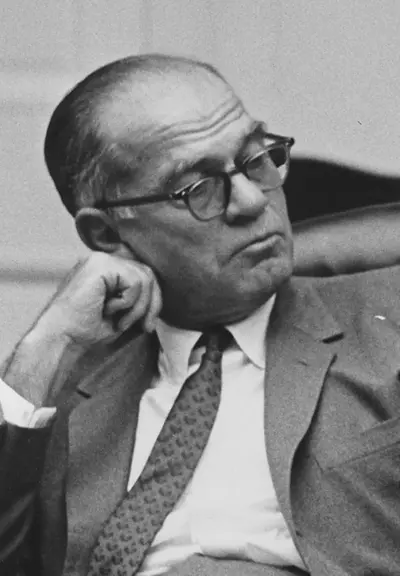
James William Fulbright was an American politician, academic, and statesman who represented Arkansas in the United States Senate from 1945 until his resignation in 1974. As of 2021, Fulbright is the longest serving chairman in the history of the United States Senate Committee on Foreign Relations. He is best known for his staunch multilateralist positions on international issues, opposition to American involvement in the Vietnam War, and the creation of the international fellowship program bearing his name, the Fulbright Program.
