Whittaker Chambers Quotes
… all of us … have slowly come to question his judgment and to fear acutely that his flair for the sensational, his inaccuracies and distortions … will lead him and us into trouble … it is no exaggeration to say that we live in terror that Senator McCarthy will one day make some irreparable blunder which will discredit the whole anti-Communist effort.
Chambers was prescient and to the regret of the right wing, did not listen to him. The reality was that McCarthy, unscrupulous, mentally unstable and an alcoholic intimidated even his own party members and this one sick and flawed individual intimidated and threatened to entire American political establishment. Although Chambers called for the Republican Conservatives to act, it was the liberals of both parties who finally took him on, exposed him and brought him down.
Whittaker Chambers, 1901-1961, Editor, Time, Letter to William Buckley Jr.
Sourced by: Eigen's Political and Historical Quotations

At the time McCarthy made this statement he was suffering from an advanced state of alcoholism. He was censured. See {619921}.


Reacting to the disarray of the federal government as a result of the activities of Senator Joseph R. McCarthy:

Many in Congress were afraid of McCarthy as he would charge that anyone who criticized him was a Communist or Communist Sympathizer. Young John F. Kennedy was one of those who was intimidated into silence. Fulbright was one of the few who had the courage to take McCarthy on. Later, McCarthy was censured by the Senate and it afterwards it was revealed that he was a paranoid alcoholic but he did a tremendous amount of damage.

See {632333} for the offensive McCarthy attack on Zwicker.


After this, no other member of the Executive branch went before McCarthy again

Referring to Senator Joseph R. McCarthy:
Introducing a resolution that was later adopted by the senate:


McCarthy was in many ways like Donald Trump. One was taht the press loved to cover his statements and accusations that were so absurd and sensational that they sold a lot of nespapers, magazines and obtained many TV / Radio viewers/listeners. As a result he got much more media coverage that he warranted in teh view of many, President Dwight Eisenhower, who generally would not even mention McCarthy's name was percieved by Adlai Stephenson and many others as weak and fearful of McCarthy, Tannenhous and some other historians believed that fear had nothing to do with it, but that Eisenhower not only chose this as a deliberate strategy, but one that was quite effective.


Even the President was not spared during the McCarthy era. The red scare was so pervasive, that a lunatic fringe ultra right wing organization could call the President a “communist dupe” and be taken seriously be much of the media who were themselves intimidated and might be accused of being communists at any moment. It was a very low point in America’s history.

Note the use of the word “alien” to describe the American owners of newspapers, radio and TV stations. Oliver was a right wing, racist, paranoid, fanatic and extremist. His quotations are interesting because he often said in public what many right wing extremists believed but only said in private. Joseph McCarthy was a senator who suffered from alcoholism and claimed that there were communists throughout the government and the military. However, while he claimed there were all these communists, he was never able to identify them. After a few years of his antics, he was censured by the Senate and he died shortly thereafter. Oliver and a few other extremists believe that McCarthy was silenced by a national communist conspiracy. However, McCarthy was never silent on anything.


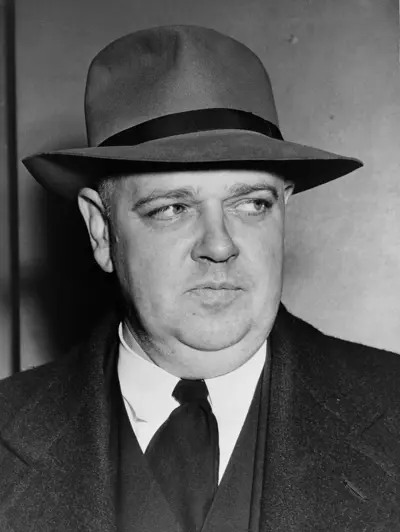
- Born: April 1, 1901
- Died: July 9, 1961
- Nationality: American
- Profession: Journalist, Writer, Spy, Poet, Translator
Whittaker Chambers was an American writer-editor, who, after early years as a Communist Party member (1925) and Soviet spy (1932–1938), defected from the Soviet underground (1938), worked for Time magazine (1939–1948), and then testified about the Ware group in what became the Hiss case for perjury (1949–1950), often referred to as the trial of the century, all described in his 1952 memoir Witness. Afterwards, he worked as a senior editor at National Review (1957–1959). US President Ronald Reagan awarded him the Presidential Medal of Freedom posthumously in 1984.
