Winston Churchill Quotes
The idea that only a limited number of people can live in a country is profound illusion. It all depends on their cooperative and inventive power.
Winston Churchill, 1874-1965, British Prime Minister (Conservative), House of Commons Debate, 1948
Sourced by: Eigen's Political and Historical Quotations


The relationship of population increase economic growth is a critical one. If an underdeveloped country manages to have a 3% annual economic growth rate and also has a 3.2% population growth, at the end of the year, the average person is actually poorer than he was the previous year. South Korea, China, Thailand and India implemented successful population control and family planning programs before they were able to take advantage of economic development. To modernize, the country must be able to have a surplus of funds which can be invested in roads, schools, hospitals, and other facilities which can produce even more growth later. Too many new mouths to feed, clothe and care for can be a barrier to development even if the economy is reasonably good.


For hundreds of years most people of the world believed this. In the latter half of the 20th century, however, a very small nation, Israel, not only defended itself against nations many times their size but did so against the attacks of all of them together. The Israelis became so powerful that many in the world began to rethink the Gervaise principle and placed more value on the educational and technological competence of a nation. Modern technology eliminated the criticality of population size.

This was an incredible prediction that few people thought was possible. This speech was given in the early days of WWII when it was far from clear that we would win.


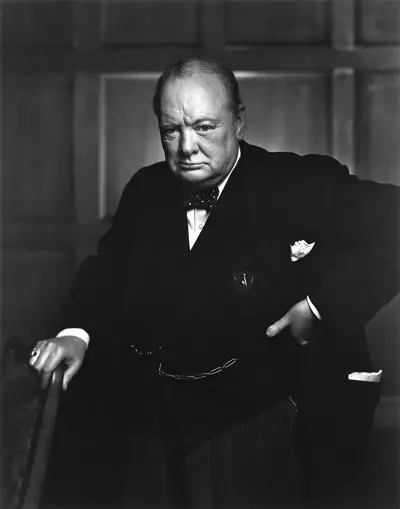
Sir Winston Leonard Spencer Churchill, KG, OM, CH, TD, DL, FRS, RA was the Prime Minister of the United Kingdom from 1940 to 1945, during the Second World War, and again from 1951 to 1955. Apart from two years between 1922 and 1924, Churchill was a Member of Parliament (MP) from 1900 to 1964 and represented a total of five constituencies. Ideologically an economic liberal and imperialist, he was for most of his career a member of the Conservative Party, as leader from 1940 to 1955. He was a member of the Liberal Party from 1904 to 1924. Churchill was also well known for his military career and as a historian, painter and writer, and among his many awards was the Nobel Prize in Literature.
