Kenneth Rogoff Quotes
The idea of the World Bank loaning money to a nation that has a space program and is building nuclear submarines is just ridiculous.
Kenneth S. Rogoff, Economist & Political Scientist, PBS News Hour, May 30, 2007
Sourced by: Eigen's Political and Historical Quotations


At the time Vidal, who shared this view with many economists, had no inkling of the digital revolution that the PC and Internet would bring, nor the other phenomena that eliminated the need for cheap labor — robotics and offshoring. Nor could he have foreseen the development of fracking making America virtually energy independent as it was before WWII. It appears that the problem has shifted from Vidal's issues, to that of what do we do with the American citizens who do not have advanced skills nor do we have methods of educating them and training them to this level. The quotation illustrates that it is always difficult predicting the future, but particularly hazardous when it comes to economics.


These loans come from either the World Bank or the International Monetary Fund, both of which are headquartered in Washington. Usually, financially distressed countries participating in such a program have to agree to a series of economic reforms which the government of the country would not make if the pressure were not there. Therefore some like Goldsmith argue that there is a loss of sovereignty.


The Organization for Economic Cooperation and Development (OECD) had proposed International Development Goal Benchmarks for donor organizations which was then officially endorsed by the World Bank, the IMF and the UN. But many people thought that many of these “benchmarks” were not only invalid but exacerbated some of the problems that they were trying to fix—especially in a developing country where structural factors inhibited class mobility and the focus was on large businesses and not small and “mom & pop” enterprises that poor could aspire to and benefit from.


This rhetoric turned out to be just that. When Israel developed a nuclear capability, the Egyptians became more rational and sobered. It was Anwar Sedate however who was the Egyptian leader wise enough and strong enough to make peace with Israel.


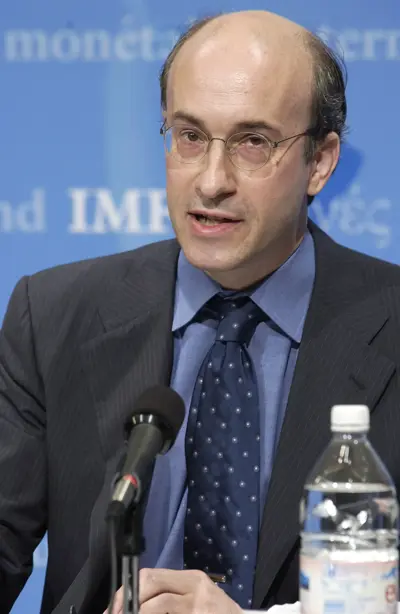
Kenneth Saul Rogoff is an American economist and chess Grandmaster. He is the Thomas D. Cabot Professor of Public Policy and Professor of Economics at Harvard University.
