Mikhail Gorbachev Quotes
There is one phase of our competition which should be brought under control —competing with each other in fueling the arms race in the Third World.... Most of these countries are desperately poor, and they need economic assistance far more than they need additional arms .... Even thought these are only non-nuclear arms, they are instrumentalities of war, and small wars always have the potential of escalating into nuclear wars.
Mikhail Gorbachev, Russian President, Foreign Affairs, Fall 1985
Sourced by: Eigen's Political and Historical Quotations


He was exactly right. See {642079} for a perfect example of this prediction.


One new danger that nuclear powers add to the usual problems of conflict, is that a nuclear power, about to lose a war in a humiliating way, might just use his nuclear weapons in revenge. So much damage will be done that the victory turned out to have been a bad thing. So ironically, with a nuclear enemy. Your military dare not win to dominantly with conventional weapons.

There were many who thought that the Russians would view the Mutual Security Act as aggressive and they might respond with some kind of aggressive retaliation and this could lead to war. Others felt that containment would reduce the likelihood of war.


He was playing the part of Captain Mandrake.


Trieste was occupied by the British and Americans theoretically, but Tito’s Yugoslavian troops had done most of the WWII fighting and dying in the area and wanted control for the Russian Allies of which Tito was then one. There were frequent armed standoff’s of Anglo Americans and Yugoslav troops that could easily have evolved to full scale fighting. Nine months later, Tito broke with Stalin. An interesting historical fact is that Richard M. Nixon was one of the Congressional Delegation then visiting Trieste.


This was the last letter she wrote from the White House after her husband was assassinated.


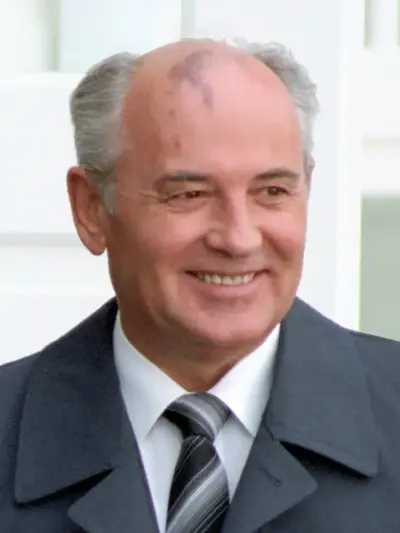
Mikhail Sergeyevich Gorbachev is a Russian and former Soviet politician. The eighth and last leader of the Soviet Union, he was the General Secretary of the Communist Party of the Soviet Union from 1985 until 1991. He was also the country's head of state from 1988 until 1991, serving as the chairman of the Presidium of the Supreme Soviet from 1988 to 1989, chairman of the Supreme Soviet from 1989 to 1990, and president of the Soviet Union from 1990 to 1991. Ideologically, Gorbachev initially adhered to Marxism–Leninism, although he had moved towards social democracy by the early 1990s.
