William Charles Cole Claiborne Quotes
The Governor of Louisiana, informed that many individuals implicated in the offences heretofore committed against the United States at Barrataria, express a willingness at the present crisis to enroll themselves and march against the enemy. He does hereby invite them to join the standard of the United States and is authorized to say, should their conduct in the field meet the approbation of the Major General, that that officer will unite with the governor in a request to the president of the United States, to extend to each and every individual, so marching and acting, a free and full pardon.
The British were about to attack New Orleans in the War of 1812 with an invasion force of their best professional soldiers. The Americans needed all the help they could get and Claiborne and the Military commander, General Andrew Jackson, came up with this idea to try and get the pirates and smugglers pardoned if they would fight against the British. They did and General Jackson with his augmented army routed the British in the last battle of the war. (It was actually fought after the war was over, but the word that the peace treaty had been signed had not yet reached either side.)
William Charles Cole Claiborne, 1775-1817, First Governor of Louisiana, Territorial Governor of New Orleans, Proclamation to The Pirates of Louisiana, 1814
Sourced by: Eigen's Political and Historical Quotations

Unfortunately, his close successors did not share Alexander’s surprisingly modern view.

While most modern armies treat officers and enlisted men who desert equally or even favor the officers, the Visigoths made desertion by an officer the severest of crimes. A centurion was the officer in charge of 100 men. There were 10 decurians (leaders of 10) under him, They were the modern equivalent of the Sergeants—non-commissioned officers. Their penalty for desertion was only the paying of a heavy fine. It was the officers who had to set the example. This set of laws is the most formalized and sophisticated compendium of laws of the so-called “barbaric peoples” of Europe. The compilation was in many ways a documentation of the traditional laws of the Visigoths that had evolved over hundreds of years.


Many of the young men who were given this form to fill out, had never been in Japan and some did not even know there was an emperor there. Nonetheless the Japanese American divisions of enlistees were the most effective and most decorated fighting units for America while their parents who had not been born in America were still imprisoned in the internment camps. See {624010}.

Surprising to many is the fact that the Federal Courts did not automatically get established when a new state joined the Union. Congress had to legally reorganize the Federal Court structure and appropriate additional money. In addition Senators then were elected by the State Legislatures who were not anxious to have any Federal Legal presence in their state if they could avoid it, as it might interfere with their State Court system. The Constitution provided for the Federal Courts but left it up to Congress to decide on all the details. It would not be until after the Civil War that the Federal Courts were very active in all States.

The British Governor was genuinely anxious to avoid bloodshed and the American Revolution. However, the conflict had been brought about by the actions of the British Parliament and the Kings ministers, and Gage did not have the power or authority to alter the issues of the fundamental conflict—taxation, colonial government, economics, self determination. While he offered pardons, in this proclamation he specifically exempted Samuel Adams and John Hancock of whom he said “whose offences are of too flagitious a nature …”
Fiji had undergone attempted coups where the nation was polarized. The issue of whether and how much to punish the coup attempters was very controversial.


See {613949} for the Governor’s letter to George Washington.

Jackson was then a general and Louisiana not yet a State.

26 years after he wrote this, both the Government and the Southern Rebels had introduced military conscription, and with few exceptions, it has prevailed through the 20th century, and then replaced by a volunteer army concept.


This Civil War recruiting poster was described by the Free Library of Philadelphia as “Civil War recruitment print targeting African Americans by evoking the freedoms granted by the Emancipation Proclamation. Depicts a montage of symbolic scenes centered around an African American Union soldier triumphantly holding up a sword and an American flag with the banner "Freedom to the Slave." He stands near broken shackles upon a tri-color flag adorned with a coiled snake. The flag is tugged upon by one of three joyous slaves freed by an African American soldier. Other scenes depict an African American man reading a newspaper on a rocking chair near a plow and child, African American children entering a "Public School" near a church, and a regiment of "U.S. Colored Troops" marching across a battlefield strewn with dead bodies.”


This historic speech is regarded as one of the most important in Australia's history, marking a turning point in Australia's relationship with its founding country, the United Kingdom. Many felt that Prime Minister Curtin was abandoning Australia's traditional ties to the British Isles. -- Wikipedia

The Chinese were massacred when the Japanese invaded with atrocities against civilians that were inconceivable until Hitler began his in Europe. However, there were many Chinese we worked against the Japanese including the Communists who made a truce with Chiang (see {636322}) so that they could oust the Japanese invaders.

President Lincoln reversed this order. Most Northerners however sided with Burnside on this point. They saw little point to protecting traitors who were helping to kill their neighbors by encouraging the Southerners.


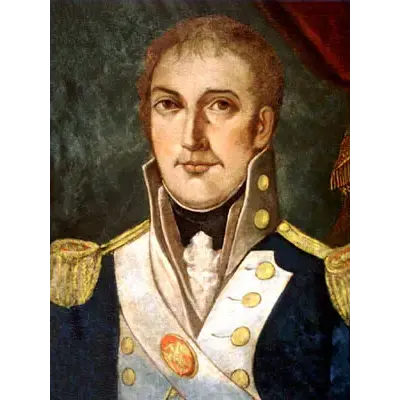
William Charles Cole Claiborne was an American politician, best known as the first non-colonial governor of Louisiana. He also has the distinction of possibly being the youngest member of the United States Congress in U.S. history, although reliable sources differ about his age.
