Aristotle Quotes
The first essential responsibility of the state is control of the market-place: there must be some official charged with the duty of seeing that honest dealing and good order prevail. For one of the well-nigh essential activities of all states is the buying and selling of goods to meet their mutual basic needs; this is the quickest way to self-sufficiency, which seems to be what moves men to combine under a single constitution.
Aristotle. The Politics. Translated by T. A. Sinclair, Penguin Books, 1962, Book VI, ch. 8.


This quotation illustrates one of White’s correct early grasps of what was happening in the political economy of the time and its future direction with growing industrialization and technological complexity. Most historians agree that White passed classified information to the Russians. He was accused of being a Communist, but there was never any evidence of that. Some people believe that he was a spy for the Russians and committed espionage, but others disagree observing that White was very much his own man and felt that much information that was classified never should have been. White substituted his own judgment, it is believed, about what could be given to the Russians for the security system. He was an admirer of what Russian socialism had accomplished economically, educationally and medically since the 1917 revolution deposing the Czar. Russia had been a valuable military ally, which had taken the brunt of both military and civilian casualties in WWII. White’s economics were certainly not Marxist but very much Keynesian. He was subpoenaed by the House Un-American Activities Committee where he was accused of being a Communist which he denied (see {634907}). He died of a heart attack 3 days later.

At the time extreme socialist doctrine was that the state should own the factories and the other means of industrial production. The socialists believed that the people through their government had to be able to control the economy and the private owners’ greed would always drive the economy for themselves and not for the society in general. Deal was one of the first who argued that there were other, less draconian modes of economic control like government regulation and central banks. Deat turned traitor during WWII and served in the Vichy Nazi cabinet of Pierre Laval. He was sentenced to death for treason but escaped to Italy where he assumed a new identity and then was sheltered by a right-wing Catholic religious order in the convent of San Vito, near Turin, where he wrote his memoirs and lived undiscovered until his death.

This statement demonstrated the classic difference that Roosevelt had with the right wing of his party and that of the contemporary Republican party. Namely they thought that the only obligation of the corporation of other business was to the owners / shareholders while Roosevelt saw the obligation to the State and the people. The State and the society gives corporations many privileges that normal businesses do not have—most important is limited liability for the corporation’s negligence or even intentional damage to people. If the Corporation had no obligation to the State and to the people, why should they get this limited liability and other benefits?


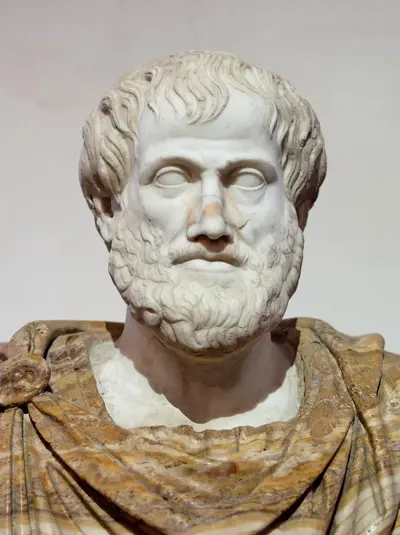
Aristotle (/ærɪˈstɒtəl/; Greek: Ἀριστοτέλης Aristotélēs, pronounced [aristotélɛːs]; 384–322 BC) was a Greek philosopher and polymath during the Classical period in Ancient Greece. Taught by Plato, he was the founder of the Lyceum, the Peripatetic school of philosophy, and the Aristotelian tradition. His writings cover many subjects including physics, biology, zoology, metaphysics, logic, ethics, aesthetics, poetry, theatre, music, rhetoric, psychology, linguistics, economics, politics, meteorology, geology and government. Aristotle provided a complex synthesis of the various philosophies existing prior to him. It was above all from his teachings that the West inherited its intellectual lexicon, as well as problems and methods of inquiry. As a result, his philosophy has exerted a unique influence on almost every form of knowledge in the West and it continues to be a subject of contemporary philosophical discussion.
