Arthur Henderson Quotes
The first condition of success for the League of Nations is, therefore, a firm understanding between the British Empire and the United States of America and France and Italy that there will be no competitive building up of fleets or armies between them.
Henderson, Arthur. The League of Nations and Labour. Oxford University Press, 1918, p. 11.


One major problem at the time was that the Soviet Union was supporting and instigating revolutions in many parts of the world. When most nations of the UN wanted to provide peace keeping troops to quell the conflict, the Russians would veto and block the effort, Vandenberg wanted the UN to change the rules regarding the veto. The original right of veto for the major nations was originally included at the insistence of the United States and many Americans did not want to give it up or have any exceptions lest there be more. The Russians at that time also did not want to give up any of their veto powers. Another method that Vandenberg wanted to solve the Russian peacekeeping blockage problem was for America to engage in more collective security pacts so that action could be taken without UN Security Council unanimity by going around the UN.


Son of John Jay. Father of Harriet Beecher Stowe and Henry Ward Beecher


The speech was the 50th Anniversary of the Speech that Secretary of State Byrne had given there exactly 50 years ago. It was referred to as the “Speech of Hope” and announced the Marshall Plan.


He was shot as a traitor when de Gaulle returned. See {587231} and {587230}.

The declaration was signed by 52 Nobel Scientists at the height of the McCarthy era.


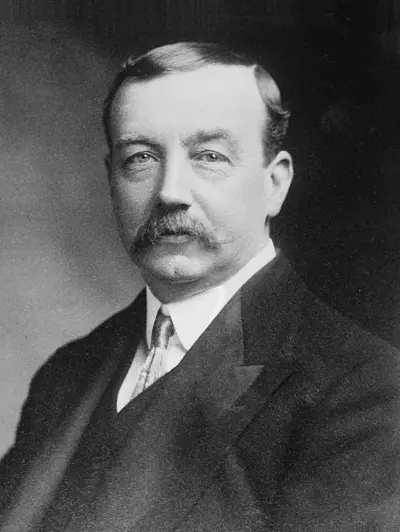
Arthur Henderson was a British iron moulder and Labour politician. He was the first Labour cabinet minister, won the Nobel Peace Prize in 1934 and, uniquely, served three separate terms as Leader of the Labour Party in three different decades. He was popular among his colleagues, who called him "Uncle Arthur" in acknowledgement of his integrity, his devotion to the cause and his imperturbability. He was a transitional figure whose policies were, at first, close to those of the Liberal Party. The trades unions rejected his emphasis on arbitration and conciliation, and thwarted his goal of unifying the Labour Party and the trade unions.
