Rutherford B. Hayes Quotes
The feeling of uncertainty inseparable from an irredeemable paper currency, with its fluctuation of values, is one of the greatest obstacles to a return to prosperous times. The only safe paper currency is one which rests upon a coin basis and is at all times and promptly convertible into coin.
Rutherford B. Hayes, 1822-1893, 19th President of the United States (Republican, OH), Inaugural Address, March 5, 1877
Sourced by: Eigen's Political and Historical Quotations


Much of the South during the Civil War lived in a fantasy universe where all the reality would not impinge upon them. Eggleston was an accomplished writer who had served in the Confederate army of the Civil War. 20 year after the war he wrote a series of articles for the prestigious Northern Atlantic Monthly trying to convey the war from the Southerner’s point of view. The South just kept printing money to take care of their perceived war and civilian needs without regard to the value of the money they were printing. Even in the 21st century collectors had a great deal of Confederate paper money, that had value only as a historical curiosity.


FDR was then a candidate for the Democratic Vice Presidential Nomination. This statement shocked some of the conservative French and British delegates and officials such as Ramsay MacDonald, Georges Bonnet, and Neville Chamberlain, but economist John Maynard Keynes strongly approved of Roosevelt Roosevelt’s statements. At issue was whether or not the major currency powers should confer frequently and set the international currency exchange rates or should the rates float and be determined at any point by the free market in currency. FDR held the latter view which was opposed to the positions of the conservative banker-oriented delegates from the European counties, However Roosevelt’s statement was considered “harsh” and “vituperative” by the conservatives and the entire conference collapsed over them. FDR admitted that perhaps he had been too strong and blunt in his language. An irony of this quotation is that 80 years later the positions of liberals and conservatives had both flip-flopped. It became the conservatives who adopted the FDR free market for currency exchange while many liberals called for government intervention and agreement on exchange rates to prevent instability.


This is a remarkable quotation in that it proposed exactly what the United States did in the Nixon administration. We went off the gold standard and backed American money with the wealth and “full faith and credit” of the nation and all its assets. It has been the strongest and most sought after currency in the world despite the fact that it is not backed by gold or silver as earlier American currency was.


There actually are restraints on how much paper money a government will issue, but unlike with a gold standard where the restraint is external and controlled by how much gold the country can amass. However, with paper money the restraints area all internal. If too much money is printed, the value of the money relative to gold, silver and other nation’s money will go down and imports will become more expensive. Excessive printing of money can easily produce inflation. However, the internal restraints can be overcome by the government’s need to raise money for war, debt or other purposes. So Paul and many other politicians have a deep distrust of paper money not backed by Gold or Silver. In the United States however, the Government does not control the money supply or the printing policies of money. This is under the control of the Federal Reserve Board which while appointed by President’s as terms expire, have a great deal of independence both from the Executive and Legislative Branches. For that reason Paul is even more distrustful when the Federal Reserve decides to print money. See {629491} for his unsuccessful effort to abolish the Federal Reserve Bank.

At the time, a bank note—paper money issued be a private bank—was not backed by any gold or silver and was not insured bym the government. A bank could print as much as they wanted, so it was always worth less as the further you were from the particular issuing bank, the less you could get your bank note, because no one knew whether or not the issuing bank would redeem the note or even be in existence. So every private bank note had diminished value for the public. However, carrying gold and silver around and making change for precious metals was difficult and often impractical. So people used banknotes. The same thing happens with credit cards today. The merchant has to pay a fee to the credit card company and the bank and therefore charges us more for whatever we buy. But most consumers and merchants are willing to pay the difference to obtain the convenience of the credit card,


At the time there was no national paper money. Individual banks printed their own and paper money was not accepted or heavily discounted most Americans. Most opposed a tender law that required paper money to be accepted in commerce.

Describing the currency situation of the country:


This is the first major history of banks written in the United States.


Later, William Jennings Bryan and the Populists turned this point into a major political issue. See Bryan’s Cross of Gold Speech.
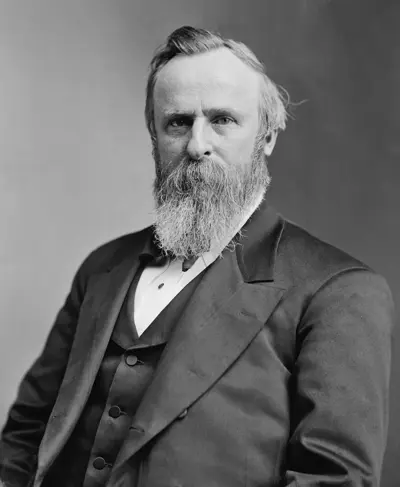
Rutherford Birchard Hayes was an American politician and attorney who served as the 19th president of the United States from 1877 to 1881, after serving in the U.S. House of Representatives and as governor of Ohio. A lawyer and staunch abolitionist, he had defended refugee slaves in court proceedings during the antebellum years. He negotiated the political agreement to end federal support of Reconstruction.
