Grover Cleveland Quotes
The several forms of our paper money offer, in my judgment, a constant embarrassment to the Government.
Grover Cleveland, 1837-1908, 22nd & 24th President of the United States (Democrat, NY), Second Inaugural Address, March 4, 1893
Sourced by: Eigen's Political and Historical Quotations

At the time, a bank note—paper money issued be a private bank—was not backed by any gold or silver and was not insured bym the government. A bank could print as much as they wanted, so it was always worth less as the further you were from the particular issuing bank, the less you could get your bank note, because no one knew whether or not the issuing bank would redeem the note or even be in existence. So every private bank note had diminished value for the public. However, carrying gold and silver around and making change for precious metals was difficult and often impractical. So people used banknotes. The same thing happens with credit cards today. The merchant has to pay a fee to the credit card company and the bank and therefore charges us more for whatever we buy. But most consumers and merchants are willing to pay the difference to obtain the convenience of the credit card,


This is a remarkable quotation in that it proposed exactly what the United States did in the Nixon administration. We went off the gold standard and backed American money with the wealth and “full faith and credit” of the nation and all its assets. It has been the strongest and most sought after currency in the world despite the fact that it is not backed by gold or silver as earlier American currency was.

At the time there was no national paper money. Individual banks printed their own and paper money was not accepted or heavily discounted most Americans. Most opposed a tender law that required paper money to be accepted in commerce.


The alternative would have been for the colonies to borrow English money at high interest rates and use that. Or use money from private banks (which occurred later.) Many conservatives are today a little shocked that some of the American Colonies just printed money with no backing but it worked—at least at the local level. A Boston Bank for example, would take a large commission for a Bostonian to convert Pennsylvania money into Massachusetts money. So it was not a very good system for trade between colonies and International trade. But English money was used for that. The colonists pragmatically got the “best of both worlds” and paid as little interest as they needed to. This system is essentially what we use today on a national scale with no gold or silver backing of the money.


America had a difficult early history with money—especially paper money which had been issued by private banks but were trusted by few. Paper money had for the first time had been issued by the Federal Government during the Civil War. Many saw it as a wartime measure but not a good practice to follow. Garfield, along with many other leaders thought that it was not constitutional for Congress to issue paper money. Others prevailed as the need for a lighter and more practical form of currency was necessitated by a growing economy. Coins for large transactions between businesses especially was very awkward when chests of coins had to be delivered to pay for cattle, produce or manufactured goods at the wholesale level.

This is the first major history of banks written in the United States.

At the time, there was no United States currency. Private banks in some of the states issued their own money. A dollar from Georgia might only be worth 75 cents in New York.


The very act of printing money created a debt—at the time and until the Nixon Administration which went off the gold standard—the government owed the gold or silver and the spicie—the printed money—was a promissory note.


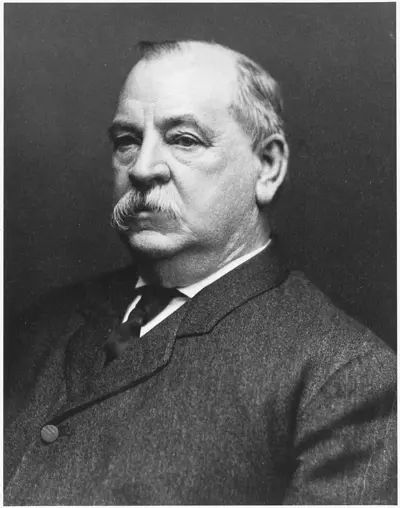
Stephen Grover Cleveland was an American politician and lawyer who served as the 22nd and 24th president of the United States from 1885 to 1889 and from 1893 to 1897. Cleveland is the only president in American history to serve two nonconsecutive terms in office. He won the popular vote for three presidential elections—in 1884, 1888, and 1892—and was one of two Democrats (followed by Woodrow Wilson in 1912) to be elected president during the era of Republican presidential domination dating from 1861 to 1933.
