George Cary Eggleston Quotes
The acts of [the Confederate] Congress authorizing issues of currency were the hastily formulated thought of a not very wise body of men, and … they were frequently susceptible of widely different construction by different officials. However that may be, it was clearly out of the power of the government ever to redeem the notes, and whatever may have been the state of affairs within the treasury, nobody outside its precincts ever cared to muddle his head in an attempt to get at exact figures. We knew only that money was astonishingly abundant. Provisions fell short sometimes, and the supply of clothing was not always as large as we should have liked, but nobody found it difficult to get money enough.
Much of the South during the Civil War lived in a fantasy universe where all the reality would not impinge upon them. Eggleston was an accomplished writer who had served in the Confederate army of the Civil War. 20 year after the war he wrote a series of articles for the prestigious Northern Atlantic Monthly trying to convey the war from the Southerner’s point of view. The South just kept printing money to take care of their perceived war and civilian needs without regard to the value of the money they were printing. Even in the 21st century collectors had a great deal of Confederate paper money, that had value only as a historical curiosity.
George Cary Eggleston, 1839-1911, Writer & Confederate Soldier, “A Rebel's Recollections”, The Atlantic Monthly, 1874
Sourced by: Eigen's Political and Historical Quotations


At the time, a bank note—paper money issued be a private bank—was not backed by any gold or silver and was not insured bym the government. A bank could print as much as they wanted, so it was always worth less as the further you were from the particular issuing bank, the less you could get your bank note, because no one knew whether or not the issuing bank would redeem the note or even be in existence. So every private bank note had diminished value for the public. However, carrying gold and silver around and making change for precious metals was difficult and often impractical. So people used banknotes. The same thing happens with credit cards today. The merchant has to pay a fee to the credit card company and the bank and therefore charges us more for whatever we buy. But most consumers and merchants are willing to pay the difference to obtain the convenience of the credit card,

Conservatives are surprised to learn that their great economic nemesis was one of the early economists who saw the danger of paper money and government control over the minting of money which is one of their core concerns.

The same argument can be made against the modern paper money supply. What Jefferson and most of the founding fathers, with the exception of Alexander Hamilton. did not realize was that the major stability of any kind of money was not only the silver or gold that backed it but the political and legal stability of the nation and the size of its productive economy. Where Jefferson was right however is that all these banknotes at the time were issued by local private banks. The Government had no responsibility for paper money and had no knowledge of how much paper money any bank issues and whether or not they had any silver to back it up. Banks didn’t trust other bank’s notes and would only redeem them at a discount. A $10 note from a South Carolina bank might only be worth $7 in New York and $6 in Boston. The early American monetary system was a mess.


There actually are restraints on how much paper money a government will issue, but unlike with a gold standard where the restraint is external and controlled by how much gold the country can amass. However, with paper money the restraints area all internal. If too much money is printed, the value of the money relative to gold, silver and other nation’s money will go down and imports will become more expensive. Excessive printing of money can easily produce inflation. However, the internal restraints can be overcome by the government’s need to raise money for war, debt or other purposes. So Paul and many other politicians have a deep distrust of paper money not backed by Gold or Silver. In the United States however, the Government does not control the money supply or the printing policies of money. This is under the control of the Federal Reserve Board which while appointed by President’s as terms expire, have a great deal of independence both from the Executive and Legislative Branches. For that reason Paul is even more distrustful when the Federal Reserve decides to print money. See {629491} for his unsuccessful effort to abolish the Federal Reserve Bank.


During the Civil War, the U. S. Government printed paper money (specie) for the first time. 20 years afterward, the paper money was still controversial.

This quotation is fascinating because it illustrates the degree to which the Southern people censored themselves on what in most cultures would be morale issues. In many ways the ability to ignore reality made it easier for the Confederate government to operate, but distorted the decisions that were made. Arguably, in most other cultures, public opinion on the reality of the situation would have brought the war to an end sooner and ironically on far better terms than they ended up with. Eggleston was an accomplished writer who had served in the Confederate army of the Civil War. 20 year after the war he wrote a series of articles for the prestigious Northern Atlantic Monthly trying to convey the war from the Southerner’s point of view.

At the time there was no national paper money. Individual banks printed their own and paper money was not accepted or heavily discounted most Americans. Most opposed a tender law that required paper money to be accepted in commerce.


This was a very astute prediction. At the time, the United States gold mining production was second only to South Africa and American currency was based on the gold standard which seemed to all to be permanent. Half a century later, the U. S went off the gold standard.


Most people owned a little land as most of America were still farmers. They had small amounts of money at different times but spent it for necessities. A relatively few people (mostly in the East) had money—gold and paper currency backed by gold. If the price of property was high, only rich could afford to buy it. The home mortgage system did not then exist, so there was no way that the average land owner could get enough money to buy land to expand farms or buy for children unless the price was low. Today, most land owners want the price of land to be high. The financial system in use at the time makes the difference.

This is the first major history of banks written in the United States.
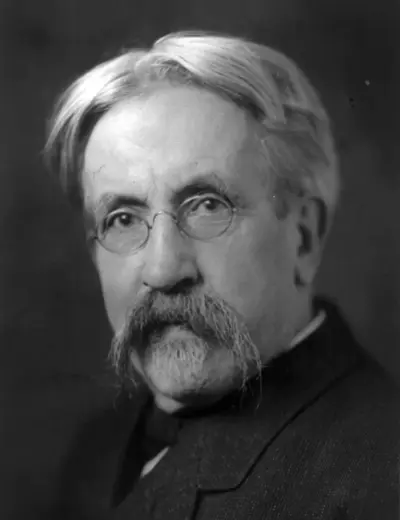
George Cary Eggleston American author and brother of fellow author Edward Eggleston (1837–1902). Sons of Joseph Cary Eggleston and Mary Jane Craig. After the American Civil War he published a serialized account of his time as a Confederate soldier in The Atlantic Monthly. These serialized articles were later collected and expanded upon and published under the title "A Rebel's Recollections."
