Tariq Ramadan Quotes
The fact that this organisation is called the Islamic State reveals something even deeper. In fact, it implies that every single Islamist party in Egypt, Iraq or Tunisia are not really representing Islam and Muslim people. Nowadays, political Islam is going through a crisis, however this crisis is necessary, for it will lead to a changing way of thinking. In order to make it out of this dead-end, reviewing political Islam becomes mandatory.
Ramadan, Tariq. "Political Islam is in Crisis." Middle East Monitor, 2015.


Perhaps this quotation gives the best insight to the major difference between an Islamic perspective of law and the Western. The latter places the rights of the individual on a par with or even superior to that of the society as a whole. The former is more concerned with the effect and result on society as a whole than concern with the individual rights of single individuals.


This quotation helps to explain the religious revelry in military achievements in Islam.


Turkey had become a modern, secular nation under the leadership of Ataturk. At the time of this interview, a religious party had won a plurality of seats in the Parliament and while not rolling back the secular nature of the Turkish state which is enshrined in the Turkish Constitution, has tried to stem the tide of secularism.
a political party. In the early days of the Muslim religion, the entire Middle East was under the authority of the Caliph who had both religious and civil authority—very much like the Pope did in Europe. However, corruption, independent tribes, feuds, and civil wars destroyed the Caliphate and there has been no common Islamic leader since. Some Muslims want to eradicate the individual countries and restore the Caliphate.


The Caliph in the past was the religious and secular leader of all Muslims. Many of the fundamentalist terrorists have as their objective, the reestablishment of the Caliphate which will unite all Islamic countries under one leader who is both the secular and religious supreme authority—a religious and a civil dictatorship. Most Muslims, like most people of all religions, are not terrorists and believe that much of terrorist activity violates many basic tenets of Islam. However, in order to function, the terrorist must have the tacit support of sufficient numbers of people so that they can function without being exposed. That is an important objective for Al-Qaeda: to enlist sufficient numbers of ordinary people who although they will not commit the terrorist acts, will support the objectives of the terrorists and provide money, shelter, and other services.
Here Khomeini takes the classic Islamic view of the Koran that leaders should be obeyed unless they do not follow Islam. To the leaders of Islamic nations, this means that even if the state is not a theocracy, the Muslim clergy has the final say as to whether a ruler may justly remain in power since they are the ones who determine if a ruler is properly following Islam.
This statement was made 20 years before the Arab Spring of 2011.


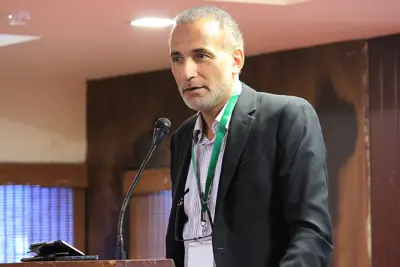
Tariq Ramadan is a Swiss Muslim academic, philosopher, and writer. He was a professor of contemporary Islamic studies at St Antony's College, Oxford and the Faculty of Theology and Religion, University of Oxford, but as of 2018 is taking an agreed leave of absence. He is a visiting professor at the Faculty of Islamic Studies at Hamad Bin Khalifa University in Qatar, and the Université Mundiapolis in Morocco. He is also a senior research fellow at Doshisha University in Japan. He is the director of the Research Centre of Islamic Legislation and Ethics (CILE), based in Doha. He is a member of the UK Foreign Office Advisory Group on Freedom of Religion or Belief. He was elected by Time magazine in 2000 as one of the seven religious innovators of the 21st century and in 2004 as one of the 100 most influential people in the world and by Foreign Policy readers (2005, 2006, 2008–2010, 2012–2015) as one of the top 100 most influential thinkers in the world and Global Thinkers. Ramadan describes himself as a "Salafi reformist".
