Wole Soyinka Quotes
The Egba kingdom was one of the very last to be ceded to the British protectorate. It remained almost an independent entity within what is now known as Nigeria, simply because of its own traditional structure of governance.
Kreisler, Harry. "Conversation with Wole Soyinka." Conversations with History, Institute of International Studies, UC Berkeley, 16 Apr. 1998.


Mobutu with Amerucan CIA and French assistance deposed Lumumba, murdered him, and seized power.

We generally associate expansionism in Africa with the European powers, but under Menelik, Ethiopia expanded its empire greatly while the Europeans were carving up other parts of Africa. When the Italians who didn’t take Ethiopia seriously, tried to grab the territory that Menelik had already grabbed, Menelik’s forces repulsed then in a humiliating defeat for Italy at Adowa in 1896. As a Christian Empire, Menelik thought Ethiopia had a right to African expansionism along with the Christian European powers as bringing Christianity to the pagans was one of the major moral justifications of African expansionism.


In one of the most unusual revolutions in world history, Brazil became independent from Portugal via a revolution led by the son of the Portuguese King and heir to the throne, Pedro I. The crown prince of Portugal, led Brazil in her breakaway from Portugal and by popular acclaim became Pedro I, Emperor of Brazil. He is probably the only monarch in history who was the heredity monarch of one kingdom and selected by popular acclaim to the throne of another.


1st Earl of Chatham. The Continental Congress had endorsed and sent to England a set of resolutions from Suffolk County, Massachusetts, drawn up by Joseph Warren. Legislators forever since have admired the logic and presentation of the case for America. The King and the Prime Minister failed to heed Pitt’s view, and the Declaration of Independence and the American Revolution followed.


The IRA had just murdered Lord Mountbatten with a bomb on his small boat. Mountbattten, then a 79 year old, elderly man in retirement was a member of the Royal Family. His grandson was also murdered. Mountbatten had not had anything to do with Ireland but to the IRA he was a symbol of British imperialism since he had been the British Viceroy of India. Actually, it was he who had organized and presided over Indian Independence.

While the official battles of the American Revolution did not begin until 1776, parts of the American colonies were in a de facto state of rebellion and the British could not enforce their laws. See {636925} for another of the King’s statements.

The violent IRA logic had always been a little tortured. At the time, the claim was that the British were not wanted in Ireland but were there only by force of arms. However, the British administration of Ireland at the time was not forceful or violent at all. Few others had the freedom and democracy of Ireland as a part of Great Britain. De Valera’s logic was that if the British in Ireland were subjected to violent, terrorist attacks, they would respond with force of arms, and thus show that they held Ireland by force. Most of the Catholics of Ireland preferred independence while most of the Protestants preferred the relationship with England.

The Ottoman Turks, at war with Russia, exterminated a large proportion of the Armenian population of the then Turkish Empire. Some of the ethnic Armenians were working with Armenians in greater Russia and thus were a risk to the Turks. However, they starved, shot, beat, hung, and bayoneted hundreds of thousands of ethnic Armenians, wiping out entire villages and towns. Despite the fact that women and little children were all killed, Modern Turkey even into the 21st century refused to admit that this was a genocide even though there was ample documentation to prove it was not spontaneous but government ordered by the “Young Turks” then controlling Turkey. See {620603} and {612638} for examples. The modern Turks maintain the view expressed during the genocide that Armenians were a threat to Turkish Independence.
He was acting as French Foreign Secretary at the time.

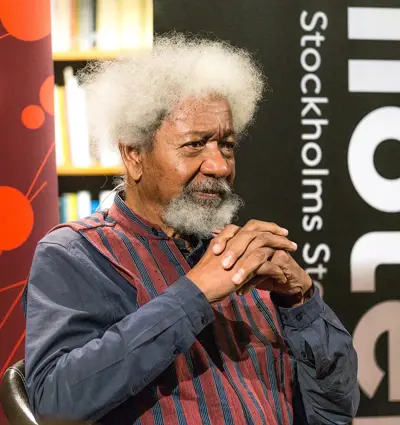
Akinwande Oluwole Babatunde Soyinka, known as Wole Soyinka (pronounced [wɔlé ʃójĩnká]), is a Nigerian playwright, novelist, poet, and essayist in the English language. He was awarded the 1986 Nobel Prize in Literature, the first sub-Saharan African to be honoured in that category. Soyinka was born into a Yoruba family in Abeokuta. In 1954, he attended Government College in Ibadan, and subsequently University College Ibadan and the University of Leeds in England. After studying in Nigeria and the UK, he worked with the Royal Court Theatre in London. He went on to write plays that were produced in both countries, in theatres and on radio. He took an active role in Nigeria's political history and its struggle for independence from Great Britain. In 1965, he seized the Western Nigeria Broadcasting Service studio and broadcast a demand for the cancellation of the Western Nigeria Regional Elections. In 1967, during the Nigerian Civil War, he was arrested by the federal government of General Yakubu Gowon and put in solitary confinement for two years.
