James Buchanan Quotes
The course of events is so rapidly hastening forward that the emergency may soon arise when you may be called upon to decide the momentous question whether you possess the power by force of arms to compel a State to remain in the Union
Buchanan, James. "Fourth Annual Message to Congress." 3 Dec. 1860. A Compilation of the Messages and Papers of the Presidents, 1789-1897, edited by James D. Richardson, vol. 5, Government Printing Office, 1897, p. 635.

Fortunately he was wrong, but the threat of a breakup of the American Union intimidated most members of Congress to avoid anything that would offend a state or group of states. Thus slavery became more and more entrenched till it exploded into the Civil War. At the time the issues of contention included the fact that Louisiana was primarily Roman Catholic and ALL other states were majority Protestant. The territory functioned under French Law—the Napoleonic Code, while all the other states operated under the English Common Law (even today this is so), and there was concern with the French and Creole language and whether the Creoles would fit into American Culture.

It would be almost 30 years until Jackson would have been proved correct and the Civil War had begun.
Jackson was reacting to the claimed right of South Carolina to nullify Federal tariffs and other Federal laws.


Later that year he sent federal troops to Little Rock, Arkansas to enforce a desegregation order.

The Governor was a staunch Confederate supporter but his state legislature majority favored the Union. He was forced out of the governorship when the 1861 election gave the legislature a veto-proof pro Union majority.


This was a decade before there was a Civil War. Secession and war had been advocated by many Southerners for years before. Most people are not aware that the move toward secession did not suddenly appear when Lincoln was elected President. It had been festering for over a decade. The other importance of the quotation is that the Southernors knew perfectly well that their actions would lead to a civil war. Some Southern apologists claim that the South never saw their actions as treason, rebellion or the cause of a civil war. This quote shows that they well knew what they were doing and the result was exactly as most Southern leaders expected.


Crittendon, at the outbreak of the Civil War, had a Governor who wanted Kentucky to secede and join the Confederacy, but he and other leaders thwarted that and the state legislatures defied the governor and forced him to resign. 16 percent of Kentucky men held slaves and keeping Kentucky and Maryland in the Union was a very high priority for President Lincoln. See {633812}.

President Ngo Dinh Diem of South Vietnam Diem was a creature of the Central Intelligence Agency. An anti-Communist Christian in a Buddhist county, the CIA engineered his rise to power, created his political party, provided him with cash to bribe other Vietnamese politicians, and paid for all the propaganda so he would “win” the Presidential elections. However, he abused the Buddhists, was thoroughly corrupt and ran a corrupt administration, but worst of all from the American point of view, he was unable to motivate the South Vietnamese population to fight the Communists. He reached the point where he was more of a liability, and the Central Intelligence Agency engineered a coup d’etat to remove him from power and replace him with a President more to our liking. (See {634540}.) Another reason this quotation is important is that it demonstrates the involvement that the Attorney General had with foreign and defense policy. Normally the Attorney General has nothing to do in these areas and is not even in the loop. But Robert F. Kennedy was also the President’s brother, and his advice was sought by President Kennedy on almost all matters. He was probably the most influential attorney general in American history.


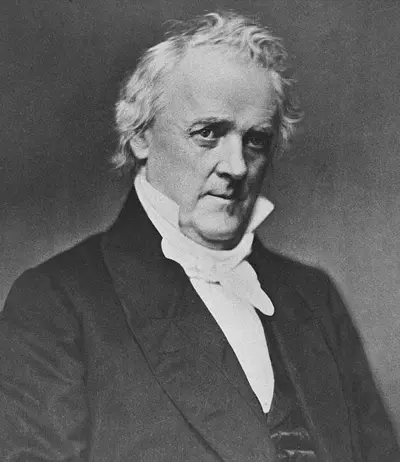
James Buchanan, Jr. was the 15th President of the United States (1857–61), serving immediately prior to the American Civil War. He represented Pennsylvania in the United States House of Representatives and later the Senate, then served as Minister to Russia under President Andrew Jackson. He was named Secretary of State under President James K. Polk, and as of 2016[update] is the last former Secretary of State to serve as President of the United States. After Buchanan turned down an offer to sit on the Supreme Court, President Franklin Pierce appointed him Ambassador to the United Kingdom, in which capacity he helped draft the Ostend Manifesto.; James McGill Buchanan, Jr. was an American economist known for his work on public choice theory (included in his most famous work The Calculus of Consent), for which he received the Nobel Memorial Prize in 1986. Buchanan's work initiated research on how politicians' and bureaucrats' self-interest, utility maximization and other non-wealth maximizing considerations affect their decision making. He was a member of the Board of Advisors of The Independent Institute, a member (and for a time the President) of the Mont Pelerin Society, a Distinguished Senior Fellow of the Cato Institute, and professor at George Mason University.
