Dwight D. Eisenhower Quotes
I cannot imagine any set of circumstances that would ever induce me to send federal troops ... to enforce the orders of a federal court, because I believe the common sense of Americans will never require it.
Later that year he sent federal troops to Little Rock, Arkansas to enforce a desegregation order.
Dwight D. Eisenhower, 1890-1969, 34th President of the United States (Republican, KS), Supreme Allied Commander in Europe, Statement, July 1957
Sourced by: Eigen's Political and Historical Quotations

Fortunately he was wrong, but the threat of a breakup of the American Union intimidated most members of Congress to avoid anything that would offend a state or group of states. Thus slavery became more and more entrenched till it exploded into the Civil War. At the time the issues of contention included the fact that Louisiana was primarily Roman Catholic and ALL other states were majority Protestant. The territory functioned under French Law—the Napoleonic Code, while all the other states operated under the English Common Law (even today this is so), and there was concern with the French and Creole language and whether the Creoles would fit into American Culture.


Explaining his civil rights strategy in the 1947 "Journey of Reconciliation:"


Ironically, many Republican leaders give lip service to decentralized government but they fight hard for centralized national government making. Many want Congress to make laws governing abortion and other family planning techniques. Some want the state to decide, but almost no Republicans want to leave these personal decisions to the local government much less the family and women involved. In business regulation as well, republican fight tooth and nail to have Federal legislation prempt state and local government about tort liability for defective products, and they always prefer that the Federal SEC make all the rules and regulations about selling stocks and bonds and do not want state or local government to “interfere”. Likewise, they have emasculated the state governments when it comes to authority over the state militias where virtually all the controls and promotions are decided by Congress and the Department of Defense and not by Governors or local politicians. Ther are many other examples. In most of the solid Republican Southern States, the local school boards cannot even select the textbooks that schools will use and the Republicans centralize this with the State government and state legislatures which they control. Democrats also are generally opposed to decentralization except for large cities having control along with the Federal government but otherwise they too do not want decentralization. For national political parties, what is the point of winning national elections of the big decisions are made locally?


Abraham Lincoln’s major political opponent in Illinois agreed with Lincoln on the criticality of preserving the Union from a split off of the Southern States. He tended to be more willing to pander to the South than Lincoln, however they were strong allies on the fundamental issue. However, what the slavery forces in the south wanted and needed to forever protect slavery was not in the power of any President to do, short of ending the democracy. Slavery was doomed in the long run if there was no way to enforce the Supreme Court’s Dredd Scott decision upon (Northern) states whose constitutions and laws made any slave who entered the state free and whose people would not use its police and legal powers to return runaway slaves. It was the abolitionists who won the majority in the battle of public opinion on slavery. It was only a matter of time when slavery would become untenable in the South. Lincoln was unwilling to force the Northern states to return fugitive slaves against the constitution, laws and will of the people of those states as Buchanan said he was (but had a hard time doing). Also Lincoln was unwilling to allow new territories to enter the union if they allowed slavery.


Kentucky was a slave state but public opinion was not clearly in favor of secession. Governor Magoffin was a Southern sympathizer and wanted Kentucky to secede with the other slave states. However, the education level of Kentucky was greater than those of the deep South and the State Legislature and many Union patriots were generally pro Union. Only 16% of Kentucky were slaves. The economy of Kentucky was much more involved with the Northern States than the other Southern states. The legislature rebuffed the Governor’s call for a secession convention. Then Magoffin demanded that President Lincoln remove the Federal Troops that had been stationed in Kentucky. Lincoln did not want the Southern forces to occupy Kentucky and then use their occupation to pressure the State into joining the confederacy. Also, Lincoln took the position that as long as Kentucky was a state of the United States, they were obligated to assist in putting down the rebellion. At this time, the Kentucky Congressional Delegation was overwhelmingly pro Union, as was the new State legislature which had such a pro-Union majority that they could override the Governor’s veto. Less than two weeks later, September 4, 1861, Confederate Major General Leonidas Polk tried to occupy Kentucky as Lincoln had feared, and the Legislature asked the Federal Government to send more troops and eject the Southern forces from the South of Kentucky. Kentucky Confederate sympathizers formed a rump government and voted to secede, and despite Jefferson Davis’s concerns that the State Legislature was being bypassed, Kentucky was accepted in the Confederacy. The result was that there were Kentucky military units in the Confederate Army and in the Union Army with the latter being in the majority. Kentucky was on both sides. This delicate balance and that of Maryland was why Lincoln did not include those states in his Emancipation Proclamation.

This surprising quote of Roosevelt’s is noteworthy for two reasons. First most of us are amazed that one of our greatest presidents were opposed to the Checks and Balances of the Constitution as it has been interpreted since Chief Justice Marshall and his Court asserted the power of Judicial Review. Second, at the beginning of the 21st century the Republicans / Conservatives opposed the power of the Supreme Court and wanted it diminished, while the Democrats were strong supporters of judicial review. In TR’s era, the parties were flip flopped. It was William Jennings Brian and the Democrats who wanted to curtail the power of the court (they had then found even the income tax unconstitutional), while the Republicans / Conservatives fought to uphold the “traditional” role of the Supreme Court. Roosevelt, not only sided with the Democrats against his own party, but went further than Bryan or any other Democrat in calling for the voter’s right to review and nullify Supreme Court Decisions that were unpopular. Needless to say, most of TR’s Republican compatriots were not happy with him, but that was not uncommon as he took on the trusts and monopolies, set up national parks, established Federal Regulation of Food, and other positions that out reformed the Democrats.

The words are those of President Andrew Jackson. See {604550}. After occupying New Orleans, General Butler infuriated the Confederate Sympathizers with this act. Jackson was the hero of the Battle of New Orleans and an unapologetic slave owner. The Southerners had erected a magnificent statue of their hero Jackson on horseback in a major section of the city. Butler, then ordered that the Jackson quotation be chiseled in the stone base. The townspeople were furious that this Union General would make up words and attribute them to Jackson; however, when they finally realized that Jackson had actually said those words they felt even more humiliated. There are still a few Southernors who consider this terrible insult to the Confederacy, and of course that is just what Butler intended.
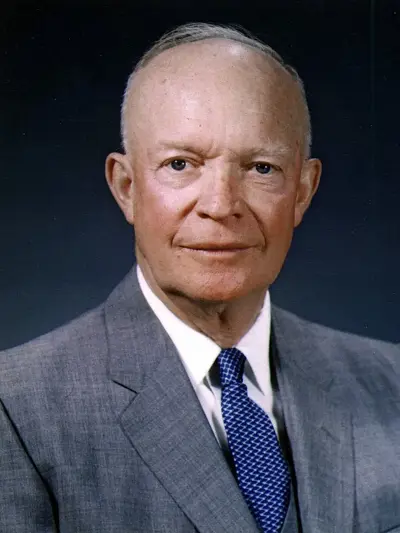
Dwight David "Ike" Eisenhower GCB OM GCS CCLH KC NPk was an American military officer and statesman who served as the 34th president of the United States from 1953 to 1961. During World War II, he became a five-star general in the Army and served as Supreme Commander of the Allied Expeditionary Force in Europe. He was responsible for planning and supervising the invasion of North Africa in Operation Torch in 1942–43 and the successful invasion of Normandy in 1944–45 from the Western Front.
