Theodore Roosevelt Quotes
When a judge decides a constitutional question, when he decides what the people as a whole can or cannot do, the people should have a right to recall that decision if they think it is wrong. If the courts have the first say so as to all legislative acts, and if no appeal can lie from them to the people, then they are the irresponsible masters of the people.
This surprising quote of Roosevelt’s is noteworthy for two reasons. First most of us are amazed that one of our greatest presidents were opposed to the Checks and Balances of the Constitution as it has been interpreted since Chief Justice Marshall and his Court asserted the power of Judicial Review. Second, at the beginning of the 21st century the Republicans / Conservatives opposed the power of the Supreme Court and wanted it diminished, while the Democrats were strong supporters of judicial review. In TR’s era, the parties were flip flopped. It was William Jennings Brian and the Democrats who wanted to curtail the power of the court (they had then found even the income tax unconstitutional), while the Republicans / Conservatives fought to uphold the “traditional” role of the Supreme Court. Roosevelt, not only sided with the Democrats against his own party, but went further than Bryan or any other Democrat in calling for the voter’s right to review and nullify Supreme Court Decisions that were unpopular. Needless to say, most of TR’s Republican compatriots were not happy with him, but that was not uncommon as he took on the trusts and monopolies, set up national parks, established Federal Regulation of Food, and other positions that out reformed the Democrats.
Theodore Roosevelt, 1858-1919, 26th President of the United States (Republican, NY), Speech, Columbus, Ohio, Quoted in The Atlantic Monthly, June 1912
Sourced by: Eigen's Political and Historical Quotations

Jefferson’s fears were later reinforced by John Marshall in Marbury v. Madison {606468}


See John Marshall's later (1803) use of the concept and term "repugnant." {606483}

Originally it was published in Boston under the name “A Columbian Patriot.” She was worried about the jurisdiction of the Supreme Court extending throughout the country and yet the nation was very much smaller then than it is today. However, transport and communications have grown with the country.
Jefferson, like most Presidents and ex-presidents, had his concerns about the judiciary and judicial checks, especially of the Executive Branch.

This shameful quotation was shocking to most readers. It is subject to two interpretations: One that judges who did not rule on Constitutional issues the way conservative extremists wanted would come to physical harm. The other, that conservatives should pressure judges by withholding appropriations for the courts, impeachments and recall elections where they exist, as well as funding potential opponents for those jurisdictions where judges are elected. Both meanings were disgraceful in the view of most Americans. Later, DeLay was convicted and sentenced to jail for money laundering and illegally spending and raising campaign funds. He was also reprimanded by the House Ethics Committee for unethical methods of fund raising for other earlier actions.


The government of Pakistan regarded this as seditious. The Government can fire judges at will and the military has the right to convene its own courts and try Pakistani civilians for certain alleged crimes by removing their cases from the civilian courts. Even when a Pakistani judge is not intimidated by the government or the military, the Islamic extremist fanatics often assassinate any public official who any one of thousands of fanatics feels is anti-Islamic.

The dramatic thing about this quotation is that in public, the mantra of conservatives about the courts of America is that they make and change laws as opposed to just interpreting and clarifying the laws. They traditionally accuse judges who rule against their favorite positions as using the courts as an instrument of political and social change. Here a leading conservative federal jurist, who thereafter became a member of the Supreme Court, was acknowledging and advocating the courts as instruments for conservative social, economic, and political change.


He served on a Supreme Court that was as close to political as any had ever been. Hence his great concern.


One of the conundrums of our constitutional system is who has the last word as to what the Constitution means. Essentially it is the judicial branch headed by the Supreme Court. But there are those who believe that the current popular majority should have a say in what is or is not constitutional. If so the legislative branch should have the last word. Still others say that the President is the only person elected by ALL the people, so his opinion most reflects the will of the public. And then there are most who argue that the Constitutional system was created just to avoid the power of currently popular majorities, and the courts should decide based on the Constitution itself. So the statement has very little meaning except that Phillips thinks that the courts have too much power. Whoever gets to decide what is or is not Constitutional will be accused of being “over” the Constitution by those who don’t like the decisions. In our system, that is the courts.


In 2002 the corrupt Indonesian Courts ruled that a very solvent Canadian company Manulife was bankrupt so that others could get control. The international financial and political community wanted the Indonesian government to intervene and reverse the rulings, but historically the courts had no independence and had been tools of the government.


Marshall did not crate this concept or some its phraseology out of whole cloth. See Rufus King {610245} for a Constitutional Convention basis for the statement.


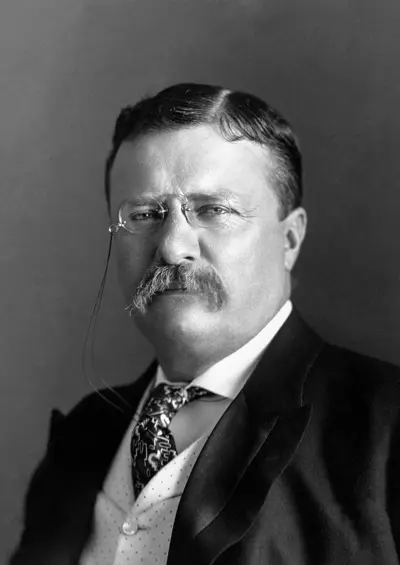
Theodore Roosevelt Jr., often referred to as Teddy or his initials T. R., was an American statesman, conservationist, naturalist, historian, and writer, who served as the 26th president of the United States from 1901 to 1909. He previously served as 33rd governor of New York from 1899 to 1900 and the 25th vice president of the United States from March to September 1901. Roosevelt emerged as a leader of the Republican Party and became a driving force for anti-trust and Progressive policies.
