Charles William Eliot Quotes
The combatants on the two sides fought with equal skill and spirit. The North prevailed, because it had more men and more military and industrial resources, and because it was fighting for Union and against slavery.
Charles W. Eliot, 1834-1926, President, Harvard University, Explanation of the Northern Victory in the Civil War, “The Next American Contribution to Civilization, Foreign Affairs, September 1922
Sourced by: Eigen's Political and Historical Quotations

Two days later Lee surrendered at Richmond, and the Civil War was over. On April 14, Lincoln was assassinated. He died the next day.

Much of the South was so insular that people knew nothing about the notion of abolition and just assumed that no one would ever consider freeing the slaves. Many never knew that it was the South that first fired on the Union troops and flag. If the North won the war, the assumption was that Northerners would then own the plantations and the valuable slaves. In reality, while all slaves were emancipated in the South, very few plantations and farms were confiscated from their Southern owners by Northerners despite the fact that there was political pressure in the North to confiscate the land of all rebels who had committed treason and use the value to repay the Union bonds and care for the wounded Union veterans and the widows of dead Union Soldiers. Eggleston was an accomplished writer who had served in the Confederate army of the Civil War. 20 year after the war he wrote a series of articles for the prestigious Northern Atlantic Monthly trying to convey the war from the Southerner’s point of view.


Gusley had been captured by the Confederates and was in a prison camp. Richardson published Gusley’s diary and Southerners were surprised to find that this Yankee who had been bombarding them from a ship was very similar to them in many ways including slavery but saw the situation regarding succession as worth fighting for preservation of the Union.


Garrison and some of the other radical abolitionists actually argued for dissolution of the Union as a means to end slavery. These abolitionists were convinced that if the United States split in two, slavery would end. See {613764} & {613626} for a description of the logic.

This was the same man who as a Senator only 4 years before threatened the North that the South was economically and militarily invincible.

The American Civil War was followed by intellectuals throughout the world. Most were offended by the immorality of the slavery that the South was fighting to maintain, but admired the way they organized and fought for their principles.


Hunton was an old West Point classmate of Sherman’s and was also a Tennessee slave holder, who wanted his escaped slaves back under the Fugitive Slave Act. Actually, Army Commander McClellan had issued an order just a few days before, prohibiting the Army of returning fugitive slaves to their rebel owners who were guilty of treason. See {619337} Sherman however wrote his friend and made a moral and ethical argument that transcended the law and at the same time pointed out the ethical hypocrisy of the treasonous Confederates.

There were some Southern Apologists who during the Jim Crow era and even into modern times, argued that slavery and the desire to maintain that was a minor cause of the Civil War but succession came about over differences in philosophy of government. This document by Mississippi made it perfectly clear why they favored succession: Slavery and their desire to maintain that institution.
This is an important quotation because it helps to dispel a myth that the Civil War was not about slavery. That was the reason that the rebelling states gave for secession, but apologists for the Confederacy have claimed that the average soldier on both sides did not care about slavery. (Two thirds of the Southern Soldiers came from families that did not own slaves; nonetheless it was clear that the main motivation of the Confederate Soldier was to protect the institution of slavery, while that of the Union soldiers was to destroy slavery.) Professor Manning found this in her book: What This Cruel War Was Over: Soldiers, Slavery, and the Civil War.

He stated that he had a vision and made these two prophesies that indeed came true. The first was the South Carolina secession starting the Civil War. The second, when the North used former slaves as soldiers who fought their old masters.

There was little thought of emancipating slaves or their value to the South by the senior officers of the Union Army at the beginning of the war. The Secretary of War however changed that. See {629184}.
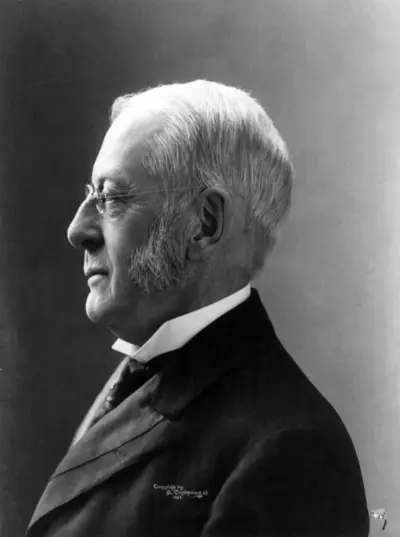
Charles William Eliot was an American academic who was selected as Harvard's president in 1869. A member of the prominent Eliot family of Boston, he transformed the provincial college into the pre-eminent American research university. Eliot served until 1909, having the longest term as president in the university's history.
