Agesilaus II Quotes
The boundaries of Sparta are on the points of our spears…. No Spartan woman has ever seen the smoke of the enemy’s camp..
No enemy had ever gotten close to Sparta. . See {632265} for a related quotation.
Agesilaus II, 444 BC-360 BC, Spartan King, Quoted in Plutarch: Lives
Sourced by: Eigen's Political and Historical Quotations

Pointing to the armed Spartan men He had been asked why there were no city walls around Sparta. See {632266} for a related quotation.


If we replace the word “socialist” with “capitalist” this statement would be approved by almost every American Senior Military officer and Defense Official as well as most members of Congress. The reality was that the basic defense posture of the Soviet Union and the United States was essentially the same during the Cold War.


First Saxon King in Britain. British King Vortigen was a very weak king with a weak military. The Picts and the Scots were at the Northern border with no defense that could stop them. Hengist the first Saxons to come to Briton made an offer that Vortigen couldn’t refuse. The Saxons would defend the Northern border and be given those provinces in return. The rest was history (See {617660}) with most people today thinking that the Saxons have been in Britain forever.
For a similar Ancient Greek version of this notion, See : {632265}.

1st Baron Verulam. The word “estate’ meant a political unit or subunit. These might be ruled by kings, dukes, war lords, etc. However, Bacon’s point was all armaments and the physical trappings of war are relatively minor when compared to the qualities of the population. With modern technology, this principle has become less and less true. Given the same technology in war, the outcome will depend on the human qualities and warlike disposition of the humans. However, a modern force with modern equipment and weapons can defeat an enemy of braver and more warlike disposition which does not have the same technology. In the modern world, a number of cultures find this a very distressing reality. The noble and courageous man should win, but Western technology, many complain, is undermining the old, traditional virtues.


This quotation illustrates several historical differences of the past with today. To be a world superpower, one had to have a dominant navy. Yet that navy was, in Churchill’s concept, a defensive system. It could protect the nation from invasion, and its merchant ships on the seas, but a navy provided no threat to invade towns and villages in Europe or elsewhere. Germany and France in contrast, with their large armies could invade other nations and menace Europe and Asia. It also illustrates why the navy and the army were considered completely separate departments of government in that they had different functions. The early American government had a Navy Department and Secretary but no Secretary of the Army or standing army.
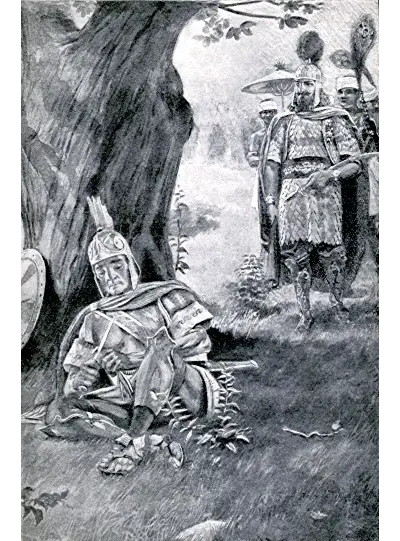
Agesilaus II (/əˌdʒɛsəˈleɪəs/; Greek: Ἀγησίλαος Agesilaos; c. 444/443 – c. 360 BC), was a king (basileus) of the ancient Greek city-state of Sparta and a member of the Eurypontid dynasty ruling from 398 to about 360 BC usually, in Plutarch's words, "as good as though commander and king of all Greece" and was for the whole of it greatly identified with his country's deeds and fortunes. Small in stature and lame from birth, Agesilaus became ruler somewhat unexpectedly in his mid-forties. His reign saw successful military incursions into various states in Asia Minor, as well as successes in the Corinthian War, but several diplomatic decisions resulted in Sparta becoming increasingly isolated prior to his death at the age of 84 in Cyrenaica.
