Ariel Sharon Quotes
If the Jewish people want to have an independent state, they must always have the sword in one hand.
Ariel Sharon, 1928-2014, Israeli Prime Minister (Likud), Army General & Defense Minister, Interview PBS, The Charlie Rose Show, May 10, 1994
Sourced by: Eigen's Political and Historical Quotations


Earlier in the Arab-Israeli conflict United Nations troops were stationed at the borders to prevent either side from attacking the other. The Arabs mounted a major attack and the United Nations troops ran and did not fight. Ever since then, Israel policy was never to depend on any other than Israel to defend the country and the people.


There was a strong movement among the early religious Christian Americans to go to the Holy Land to reclaim the Kingdom God promised in the Bible. American missionaries went to the Middle East. See {585147} for another early American politicians view.


Since the foundation of the State of Israel in 1949, there has been compulsory military service for all except the ultra-orthodox. Initially, this was only a small handful of religious scholars, but the number had swelled to almost 70,000 man of draft age who were very vocal and active about how the nation should be run and its foreign policy but never had to risk their own lives of that of their children in fighting Israel’s wars. Finally, majority sentiment became overwhelming and the exemption was removed. The Degel HaTorah party was an ultra-orthodox Jewish minor religious party whose view of a Jewish State was very similar to the ultra-orthodox Muslims who believed that holy books of their religion are the only valid laws and must supersede everything else like man-made Constitutions or laws. For them there was NO separation between church and state. For Gafni, therefore, if a court ruling or law conflicted with the Torah (the first 5 books of the Old Testament – The Law of Moses-- it contravened the notion of a Jewish State. The vast majority of Israeli Jews believed that the civil law must trump anyone’s particular interpretation of the Law of Moses as interpreted by the ultra-orthodox or anyone else. See {636124} for another instance where Gafni complained that Israel was no longer a Jewish State.


This is the first statement of a Jewish nation since Biblical Times.
at the First World Zionist Congress, 1897


This quotation is very surprising for most people. Reading the text alone, most of us would assume that it came from someone when the Zionist movement was fighting for a Jewish homeland in what is now Israel. Or just before the UN decision in 1947 to partition Palestine. However, it came from one of our founding fathers in Colonial times. Adams was by no means the only Founding Father with this point of view. Fundamentalist Protestants have put much credence in God’s granting the area for the Jewish People—then as today.

After the attack on Fort Sumter, the South Sent “diplomats” to negotiation with the Government. Unfortunately for all, the South really was not open to negotiations as they only had two predetermined positions they would agree to: The first was that the Government should guarantee the perpetual right of states to have slavery if they wished and that fugitive slaves would be returned by the non-slave states. The second was that the Union should recognize the Confederacy as an independent nation and have peaceful relations between the two. The first was impossible to deliver even if the Union would agree to continue slavery, there was no way that the Federal Government could enforce the return of fugitive slaves from many northern states where they were free the second they set foot in the state, and the Northern states demanded States Rights and not being forced to return Fugitive Slaves forcing the Southern States to oppose States Rights when it came to Fugitive Slaves while favoring it for slavery itself. The Federal government could not enforce the Dred Scott Decision under the pro-South Buchanan administration. And Lincoln and most of the Northern Politicians would not accept a complete dissolution of the Union. There are no other possibilities the South would accept and there was really nothing to negotiate.


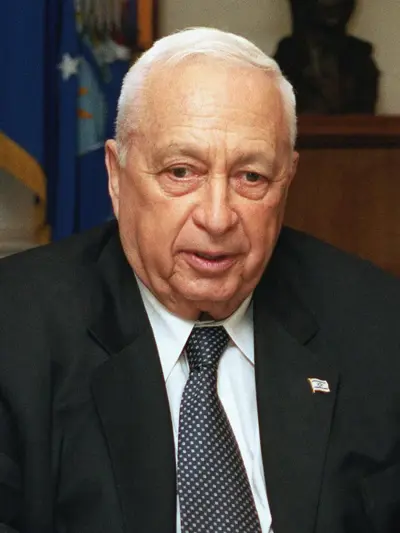
Ariel Sharon was an Israeli general and politician who served as the 11th Prime Minister of Israel from March 2001 until April 2006.
