Naftali Bennett Quotes
We need to do everything possible to save the Jewish state. We don't have another Jewish state.
Remnick, David. "The Party Faithful." The New Yorker, 14 Jan. 2013.


at the First World Zionist Congress, 1897
This is the first statement of a Jewish nation since Biblical Times.

This quotation is very surprising for most people. Reading the text alone, most of us would assume that it came from someone when the Zionist movement was fighting for a Jewish homeland in what is now Israel. Or just before the UN decision in 1947 to partition Palestine. However, it came from one of our founding fathers in Colonial times. Adams was by no means the only Founding Father with this point of view. Fundamentalist Protestants have put much credence in God’s granting the area for the Jewish People—then as today.


He also expressed his pleasure with the British Balfour Declaration granting the Jews their own country in part of Palestine ({594001}). Wilson had earlier committed himself to support the Zionist claim for Palestine. See {585124}.

The President was referring to the fact that most Arab governments constantly attacked Israel with an end of “wiping them off the face of the map” or “pushing them into the sea.” When Palestine was partitioned into Jewish and Arab states, the Israelis developed their part into a modern industrial democracy with the highest standard of living and political freedom in the Middle East despite having to fight off repeated Arab attacks who resented the fact that non-Arabs controlled any land of the area and that their dictatorships and monarchies were always embarrassed by the success of this “foreign” and “European” force in their midst.

The recommendation for partition was the basis of the decision of the United Nations in 1949 to partition Palestine.


Prior to 1948 and the establishment of the state of Israel, there were large number of Jewish refugees who were stateless and, regardless of whatever moral rights they may have had, there was no politi.cal mechanism to enforce or claim these rights. For example, in 1956 Nassar expelled most of the Egyptian Jewish population. It was only the existence of Israel that gave these people the right to come to Israel and not depend on the good will of the world to help them as refugees. The difficulty for most refugees is that there is no state to demand, support, and enforce their rights.


Since the foundation of the State of Israel in 1949, there has been compulsory military service for all except the ultra-orthodox. Initially, this was only a small handful of religious scholars, but the number had swelled to almost 70,000 man of draft age who were very vocal and active about how the nation should be run and its foreign policy but never had to risk their own lives of that of their children in fighting Israel’s wars. Finally, majority sentiment became overwhelming and the exemption was removed. The Degel HaTorah party was an ultra-orthodox Jewish minor religious party whose view of a Jewish State was very similar to the ultra-orthodox Muslims who believed that holy books of their religion are the only valid laws and must supersede everything else like man-made Constitutions or laws. For them there was NO separation between church and state. For Gafni, therefore, if a court ruling or law conflicted with the Torah (the first 5 books of the Old Testament – The Law of Moses-- it contravened the notion of a Jewish State. The vast majority of Israeli Jews believed that the civil law must trump anyone’s particular interpretation of the Law of Moses as interpreted by the ultra-orthodox or anyone else. See {636124} for another instance where Gafni complained that Israel was no longer a Jewish State.

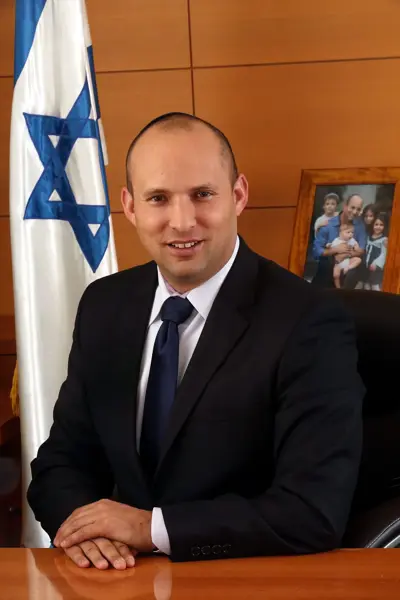
Naftali Bennett is an Israeli politician who led the Jewish Home party between 2012 and 2018 and currently serves as an MK for New Right. Between 2013 and 2015, he held the posts of Minister of Diaspora Affairs, Minister of Economy and Minister of Religious Services. From 2015 he continued as Minister of Diaspora Affairs and became Minister of Education. From 2019 to 2020 he was Minister of Defense.
