Samuel Alito Quotes
The bill of rights applies at all times and is particularly important in times of war and national crisis.
There are some who believe that in a time of national emergency the government has the right to suspend the bill of rights or any other constitutional provision. This view is typically held by most foreign governments and they do this all the time. However in America, there is a general consensus that emergency does not vitiate the constitution. However even President Abraham Lincoln tried to suspend aspects of the Bill of Rights during a national crisis.
Samuel Alito, Supreme Court Justice, Statement at his confirmation hearing January 10, 2006
Sourced by: Eigen's Political and Historical Quotations

Hamilton acknowledged that the major public objection to the new U. S. Constitution was its lack of a Bill of Rights, which Hamilton argued was unnecessary.

There is no declaration of rights … the declaration of rights in the separate states are no security
See Rufus King for the opposite position. {610244}


Note the use of the phrase “against the government.” One of the unique aspects of the American Constitution and The Bill of Rights is that the government is considered a potential and even probable infringer on the liberties of the people. It is almost as though the government was the potential enemy. Modern libertarians state this very explicitly and it is ever present in the views of both the right and left wings of American politics. Most centrists recoil at the thought that some citizens see the government as the enemy, but even in America there have been times where the government has infringed on the rights of citizens only to have the courts or future administrations and Congresses correct the error.


Arguing for a Bill of Rights to assuage public objections to the original Constitution:


See George Mason for the contrary view. {606646}


Mosley had been incarcerated without charges or trial under the “national emergency” of the Second World War. This prevented him from organizing his “Blackshirts.” When it was clear that Germany would lose the war, Oswald was released, but without the prospect of Fascism dominating continental Europe, there was little interest in Fascist movements in England.

In a 1949 dissenting opinion in Terminiello v. Chicago Jackson claimed the majority view would “convert the Bill of Rights into a suicide pact.”

Many New Yorkers and others felt that since the attack on the World Trade Center was made in the name of Islam, the mosque and commuity center should be built in another location further from Ground Zero. Ellison was debating someone who argued that the Mosque should not be built so that sensitivity can be shown for those New Yorkers who lost relatives and friends in the attack of September 11. Rather than insist on their Constitutional rights, the Muslim leadership of the project, moved the location somewhat further away from Ground Zero.

Responding to suggestions that drug traffickers be summarily executed:


This is probably the first known use of the Bill of Rights phrase in the English language. For the earliest American use, see Edward Rutledge.
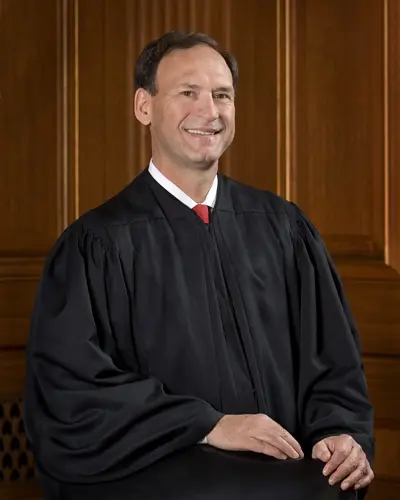
Samuel Anthony Alito Jr. is an associate justice of the Supreme Court of the United States. He was nominated by President George W. Bush on October 31, 2005, and has served since January 31, 2006. He is the second Italian-American justice to serve on the Supreme Court, after Antonin Scalia, and the eleventh Roman Catholic.
