Grover Cleveland Quotes
The best way for the Government to maintain its credit is to pay as it goes—not by resorting to loans, but by keeping out of debt.
Grover Cleveland, 1837-1908, 22nd & 24th President of the United States (Democrat, NY), Second Inaugural Address, March 4, 1893
Sourced by: Eigen's Political and Historical Quotations

This is a particularly interesting historical quotation. It shows that when FDR was first elected, he had a classic view of deficit spending. However, above all, Roosevelt was a pragmatist and not an ideologue. Faced with the Great Depression that was not getting much better, Roosevelt turned around, changed his mind and policy about deficits and embarked on the “pump priming” approach of injecting substantial Federal spending into the economy and accepting the deficits in order to improve the situation which had been stagnant. FDR’s new policy staved off total disaster, but few remember that his great success was a total reversal of his earlier views.


Perry was one of a number of politicians who became opposed to deficit spending, and claimed that the public was not interested in the various projects. However, whenever any of these politicians proposed projects or programs to cut, there would be many citizens who would object vehemently. It was precicely because there was a constituency supporting all the government programs that politicians found it so hard to keep spending under control. Indeed, when others suggested terminating spending on programs and projects Perry liked, he objected as strenuously as most others.


In 1964 the treasury secretary asked the president how to sell the proposed budget to Congress:

Almost every major corporation that is growing must borrow money to finance the growth. There is a great temptation to do this continuously, as if all works out the borrowed money is paid back and the nation has grown. However, not every investment succeeds, and when they do, few nations will take the growth and save it for a future date when a national investment does not work out as well as hoped. Gradually national debt as a proportion of the economy gets larger and larger and it makes mew investments more and more difficult to succeed because of the higher rates of interest that must be paid. Every modern country must find a balance. Those that do not can have a financial disaster such as Greece in the early part of the 21st century.


After many years of deficit financing, Clinton finally produced a balanced budget and together with his Secretary, of the Treasury, Robert Rubin, actually developed an economy which was producing a huge annual surplus that would soon eliminate the national debt. However, when George W. Bush replaced Clinton after two terms, Bush was unable to manage the budget any better than the other aspects of the Presidency. He cut taxes dramatically and even after it was clear that the Clinton surplus was squandered, he continued tax reductions and even increased them while increasing government spending creating the biggest government in history and went from our largest surplus to our largest deficit in his 8 years.

An unusual feature of the American governmental budgeting process is that Congress has passed a law limiting the amount of debt that the United States can maintain. When there is deficit financing, the law limiting the debt has to be changed periodically as the nation approaches the debt limit. Partisan politicians often take advantage of the fact that the debt limit must be passed and hold the passage hostage to obtaining something they want. The reality is that when Congress passed the previous budgets, they determined what the debt would have to be later. So they have already voted to exceed the budget ceiling. But the requirement of doing it in a second forum allows more pressure to be placed on the administration and the other party’s Congress members. While this process is ongoing, many people in the world are worried and often terrorized by the prospect of the debt ceiling not being passed, in which case the United States would have to default on its obligations—not pay interest, contractors, retirements, salaries, etc. Hence the admonition that the debt ceiling should never be a part of the budget negotiating process by most responsible statesmen and women. But the mist partisan of the politicians want to play politics with the debt ceiling precisely because the stakes are so high and they can get both headlines and leverage.

Historically, this is the occasion where the war debt from the Revolution and the War of 1812 was paid off. It was one of the few times that the nation was debt free.


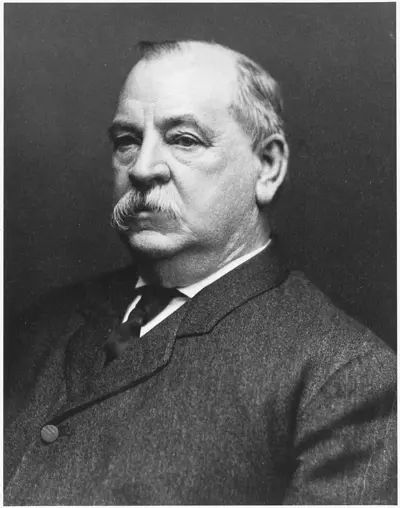
Stephen Grover Cleveland was an American politician and lawyer who served as the 22nd and 24th president of the United States from 1885 to 1889 and from 1893 to 1897. Cleveland is the only president in American history to serve two nonconsecutive terms in office. He won the popular vote for three presidential elections—in 1884, 1888, and 1892—and was one of two Democrats (followed by Woodrow Wilson in 1912) to be elected president during the era of Republican presidential domination dating from 1861 to 1933.
