William N. Haskell Quotes
The American Relief Administration is now feeding about 800,000 children in Russia, plus 300,000 in the Ukraine …. However, both of these programs must be increased, beginning January, for a period of five months. The average need from September to June, inclusive, will be about 1,000,000 children in Russia plus 300,000 in the Ukraine…. it is estimated that in January 600,000 of the adult population will be short of food on the Volga and 400,000 in South Ukraine will face starvation. It is estimated that an average of 1,000,000 adult rations for five months would prevent this starvation. I believe the Russian Government will be unable to handle the situation, despite early optimism. The situation of the needy will be worse this year because they have less personal possessions to exchange for food. The intelligentsia will be particularly in need. Clothing is more necessary this year than last. Our medical resources are sufficient.
In one of its most effective relief programs, the United States saved millions of Russians in the famine of 1921-1922. However, millions more starved to death and died of disease. The United States had at any one time 200 Americans, under Herbert Hoover, who were fighting to save as many as possible despite some on America wanting to show how the Communist Government was incapable of handling the situation, which they clearly were.
William N. Haskell, 1878-1952, Director of Russian Relief in Moscow, American Relief Administration, Army General, Cable to Washington, September 21, 1922
Sourced by: Eigen's Political and Historical Quotations

Two of the major issues of the War of 1812 were the right of American ships to trade in Europe. The British were at war with France and boycotted all ports controlled by the French. They would seize American ships bound for or having traded with French areas. In addition, many American merchant seamen had formerly served in the British Navy and British warships would stop American merchant ships and remove “suspected” deserters and force them into British military naval service. Captain Lawrence was mortally wounded in this battle. See {625136}.

In one of its most effective relief programs, the United States saved millions of Russians in the famine of 1921-1922. However, millions more starved to death and died of disease. The United States had at any one time 200 Americans, under Herbert Hoover, who were fighting to save as many as possible despite some on America wanting to show how the Communist Government was incapable of handling the situation, which they clearly were.
In 1921, there was a terrible famine in Communist Russia. The United States was ambivalent about humanitarian relief to the leading Bolshevik county while there were Communist supporters in the U. S. who were setting off bombs and calling for the overthrow of the democratic government. Herbert Hoover persuaded President Warren G. Harding that food aid relief was a moral obligation and would do much to weaken Bolshevism. 400 ARA Americans went to Russia and hired over 120,000 Russians to implement the relief program. Rarely in human history have this few people with the resources made available to them saved as many lives as Hoover and his staff did. A number of the Americans died in Russia from disease and those who survived worked under near impossible conditions. Ironically, while it created much good will towards the United States, many including Hoover suspected that the program and the pressure that the Americans put on the Soviet Government officials for more efficient administration may have forced the Soviet Government to learn how to organize much of othe society like the railroads, thus strengthening the Communist Party’s control over the country.


The “gentlemen: were 4 ultraconservative members of Congress who objected to our sending surplus food to India when they had a terrible famine. India was “non-aligned” in the Cold War and the Congressmen did not want to send them food unless they allied with us against the Russians. India was a fledgling democracy at the time and was vulnerable to bad weather and crop failure. Once, our food helped them get on their feet, they improved their agricultural production and today they have sufficient food stored so that they can survive major agricultural crises.

Most American policy makers have believed that food should not by used as a weapon on moral and humitarian grounds. Butz was an ultra-conservative who were among the few that were willing to use food to achieve political opbjectives even it it meant starving people in other countries.


After the World War I armistice there were 7,000 American troops remaining in Russian Siberia to the chagrin of the Secretary of War who wanted them removed. One reason given for their presence was to "protect our relief efforts there:"


Vladimir Lenin. Uyezds were small towns and cities in an administrative subdivision of Russia. For Americans, hoarding has been a reprehensive policy for greed and personal gain, where the consequence for most people was inconvenience and loss of money. But in Russia hundreds of thousands of people starved to death while hoarders of food wanted to hold out for higher prices. To Lenin and many others, hoarding was mass murder and that was exactly its effect.

There had been a Ukrainian coup where the pro-Russian President of Ukraine was ousted and a new Parliament elected that was more inclined to Europe and the West. Unfortunately, several of the key members of the new regime were neo-Nazis. Ukraine had a nasty past where during WWII over 200.000 Ukrainians joined Hitler’s Nazis and fought against the 800,000 Ukrainians fighting with Russia and the Russians. The Ukrainians even ran the only death concentration camp no operated by Germans. Russia used the presence of some Nazis and the passage of the first Ukranian law of the new Parliament that prohibited the use of Russian in Ukrainian schools to come to the “aid” of the ethnic Russians living near the Russian border at the Eastern end of Ukraine who had seized the governments of several areas and forced the Ukrainian officials out and with the help of Russian “volunteers” with Russian weapons, prevented Ukrainian troops from reasserting control. In the struggle there were deaths on both sides of the conflict and these were the “peaceful civilians” who were “annihilated”.


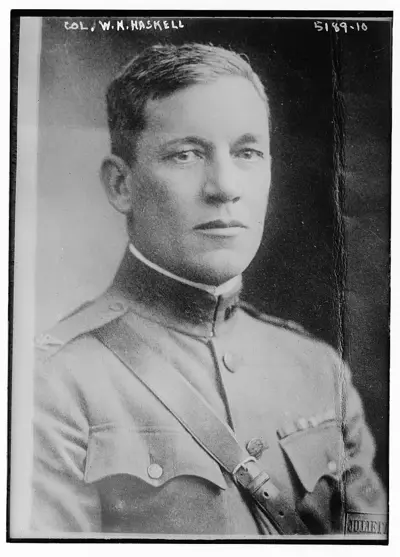
Lieutenant General William Nafew Haskell Jr. was a US military officer. Haskell was a graduate of the United States Military Academy.
