Charles Hamilton Houston Quotes
The American color bar, unless speedily removed, will be the rock on which our international Good Neighbor policy and our pious claims to moral leadership will founder.
Charles Hamilton Houston, *-1950, Executive Secretary, NAACP, Speech, Conference on America's Opportunity to Create and Maintain Lasting Peace, New York, October 1944
Sourced by: Eigen's Political and Historical Quotations


Ironically Fort-Whiteman was arrested in Moscow in one of Stalin’s massive purges and sent to a Soviet Gulag where he died of starvation. He was one of several Americans who were Stalinist victims. Ironically, he was right about Blacks and revolutionary change, but whereas he thought the “revolution” would be a socialist and communist one, the “Civil Rights Revolution” was a legal, cultural and intellectual one. However, statements like this were taken advantage of by white racists who saw in every attempt to right the wrong of racial discrimination, a communist revolution in the making.


This became one of the most widely quoted statements of the 1960s and 1970s.


Vladimir Lenin. In their quest for world revolution, the Russian Communists had more problems with arguments in the United States whose reforms and economy had produced a very high standard of living. They knew that to effect a revolution, they had to reach the middle class and the intellectuals. They had little economically to attack America with but they were able to attack the United States morally. Even though segregation was legal in America at that time, many Americans thought it immoral. Most of the rest of the world did also. So that was one of the attack points. Since the communists opposed U. S. racial segregation, many Southern segregationists used a perverted logic and accused everyone who opposed segregation of being a communist. In addition to racial segregation, the Communists attacked other forms of discrimination such as anti-Catholic, anti-Asian, and anti-Semitic (See {638737} ) behavior.

This quotation is one of the most enlightening about Reconstruction. The Congress was debating the first Civil Rights Act and Harris was one of the few Southern Whites left in the Congress as Maryland had not seceded. He told the other members of Congress that no matter what they did including passing the Civil Right Act of 1866, the states will ultimately control what happens in the states without worring about the Federal government. All the efforts at equality and civil rights would fail, and the Negro must be kept inferior. Harris lost the debate and the Civil Right Act of 1866 was passed. It was vetoed by the Southern President Andrew Johnson but both Houses of Congress overrode the veto easily. But Harris was right historically as to what would happen, and it would be 100 years before civil rights legislation would be meaningful.

Referring to Montgomery Alabama in 1950.
Some whites opposed Slavery and new slave states, not becasue of any sympathy with Negroes or concern for the immorality of slavery, but becasue slavery made it difficult for the working white man to thrive.

The president was commenting on a Donald Trump campaign statement that African American were in the worst shape in history when the reality was just the opposite
[This was the first Abolition appeal written by a Black Man. It was published in Boston and despite the fact that it was very critical of whites, was very popular going through two more printings within the next two years.]

The Federal Housing Authority actually developed policies that literally prohibited private mortgage lenders from writing mortgages for black neighborhoods and to not lend to blacks who wanted to buy houses in predominantly white neighborhoods. The Nuremburg Laws were the laws passed by Nazi Germany to make prohibit Jews from engaging in most civil activities.
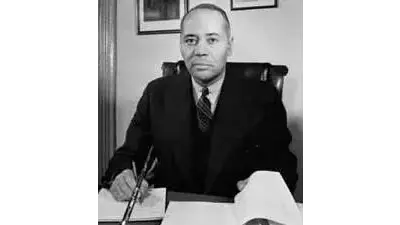
Charles Hamilton Houston was a prominent African-American lawyer, Dean of Howard University Law School, and NAACP first special counsel, or Litigation Director. A graduate of Amherst College and Harvard Law School, Houston played a significant role in dismantling Jim Crow laws, especially attacking segregation in schools and racial housing covenants. He earned the title "The Man Who Killed Jim Crow".
