Thomas Huxley Quotes
That which lies before the human race is a constant struggle to maintain and improve
Thomas Huxley, 1825-1895, British Biologist & President of the Royal Society, Evolution and Ethics, 1893
Sourced by: Eigen's Political and Historical Quotations

Darwin’s work had polarized England into two camps. Spencer was one of the major public supporters of Darwin. Tennyson expressed a similar intuitive view a decade earlier {627586}. Spencer reasoned that if an egg cell and a sperm cell could produce a human in 9 months, why was it not plausible that the cell could become a human in hunreds of millions of years.

Essentially, he was expressing a Darwinian idea in poetry. See Herbert Spencer {627582} for an even more specific argument for the same point.


See President Clinton’s quotation at the same press conference {628400}.


Man will put foward a goal to raise himself to a new level to create a higher sicio-biological type.
He was one of the very early thinkers who realized that one of the major implications of Evololution was that man would likely try to manipulate the many variables taht could effect evolution to forther develop ouyr species. It took until the end of the 20th centrury before man actually tried to do this.


Darwin believed at the time that large populations were critical to national success and development. The next 100 years would prove that large population was a handicap to progress and real growth of standard of living.


The magnificent result of modern civilization has been to extend the average lifespan of humans by decades. What Galton called “weakly lives” are those that were eradicated by smallpox, bubonic plague, polio and hundreds of other diseases and risks where we have strengthened mankind and not simply succumbed to all the many natural dangers. At the same time however, civilization has added risks and dangers to human life. Automobile crashes, industrial accidents and the like. The balance has been well in favor of “civilization.”

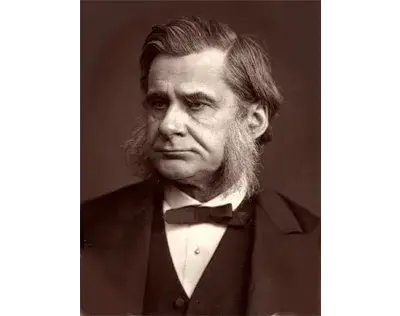
Thomas Henry Huxley PC FRS HonFRSE FLS was an English biologist and anthropologist specialising in comparative anatomy. He is known as "Darwin's Bulldog" for his advocacy of Charles Darwin's theory of evolution.
