Minh Mang Quotes
Thanks to my generosity, imperial troops were dispatched to Cambodia, costing millions of coins, and brought you security by destroying the Thai. Our soldiers were stationed among you to bring you peace. This was like bringing the Cambodian [Khmer] people out of the mud and into a warm feather bed, and this is well-known by all …. Anyone who can think for himself should be grateful to my court; why are there people who hate us?
Thailand had invaded Cambodia, and Vietnam intervened and repulsed the Thai. However, they tried to “civilize” the backward Cambodians, and these efforts at cultural and political reform were no appreciated. A full scale rebellion broke out. See {607693} and {43139}. The Vietnamese, the stronger, generous power who had provided so much, could not understand the anti-Vietnamese feeling.
Minh Mang, 1791-1841, Vietnamese Emperor, Decree to the Cambodian People, 1840
Sourced by: Eigen's Political and Historical Quotations

At the time Cambodia was a “third world” nation and Vietnam a regional superpower.

Scowcroft and Colin Powell had been key military and security advisors to President George W. Bush’s father when he was President. The younger Bush had no foreign policy or military experience, and he and his party assured the public that with men like Scowcroft and Powell advising him, all would be well. However, when Bush thought of invading Iraq, Scowcroft and Powell strongly advised him against it, but the younger Bush ignored the advice of these men who had served the nation so well under his father. Scowcroft’s warning could not have been more accurate.


See {636935}for the policy decision that triggered this order.


Previous Sultans had developed a large army of Black Moors. Then there was a civil war in Morocco where the light skinned Moroccans fought against those of dark skin. The light skins won and the new Sultan ordered the remnants of the Black soldiers with their families to Larache where he surrounded them by Arabs and simply gave the Blacks to the light skinned Arabs as slaves.

At that time Jews in Palestine were in the minority. The issue of how to obtain the land was hotly debated amongst Jewish groups. Jabotinsky was at one extreme—colonize and take the land just as the Arabs had done to the Jews when there was a Jewish majority. His view did not however prevail. The policy was to buy the land from individual Arabs and Jewish land up to 1948 was obtained that way. In that year the UN partitioned Palestine and 11 Arab armies attacked the new state of Israel and asked the Arab civilians to leave the area so that the Army could cleanse it of Jews. Many did not, and they or their descendants are still on their land or have sold it. The Arabs who left, were suspected of being possible collaborators or terrorists, and they have never been paid for their land or allowed to return. Compensation is still in dispute. At the same time Jews driven out of Arab countries by law and the military have never been compensated or given any right of return either.


Nguyê~n Phu' C A' nh. Cambodia was also considered a backward and barbarian country. Essentially, the Emperor’s plan was for Vietnam and Thailand, the two dominant powers in the area, to share hegemony over Cambodia. That is exactly what happened, and to this day, both countries exercise a great deal of control and influence over Cambodia. For example, even in 2000 Cambodian textbooks and curricula came from Vietnam.


The Barbary Pirates had an incredible extortion racket going in the Mediterranean. If nations would pay them an annual sum each year, they would not attack and seize merchant ships of that country and sell the ships and goods while holding the sailors for ransom. President Jefferson had first dispatched American warships and authorized a major land operation which were very effective. Finally, a treaty was negotiated but Decatur reminded the Navy of what brought the Algerians to the negotiating table.

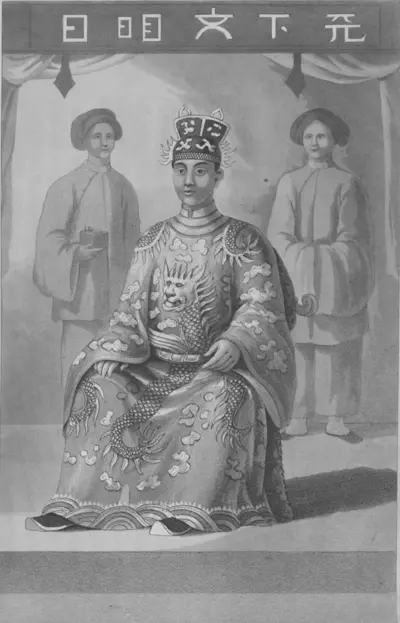
- Born: May 25, 1791
- Died: January 20, 1841
- Nationality:
- Profession:
Minh Mạng was the second emperor of the Nguyễn dynasty of Vietnam, reigning from 14 February 1820 until his death, on 20 January 1841. He was the fourth son of Emperor Gia Long, whose eldest son, Nguyễn Phúc Cảnh, had died in 1801. He was well known for his opposition to French involvement in Vietnam and his rigid Confucian orthodoxy.
