Vladimir Lenin Quotes
Take immediate and decisive steps to better the condition of the peasant. Abandon the system of war-time Communism by which we practically took from the peasant all his surplus, and sometimes what was not his surplus but part of his necessary subsistence.
Vladimir Lenin. The “war-time” referred to the Civil War in Russia which broke out after the 1917 Revolution where the Whites and the Reds fought for control of Russia.
Nikolai Lenin, 1870-1924, Russian Communist Premier, Speech, April, 1921
Sourced by: Eigen's Political and Historical Quotations

Official `Russian Communist Party Publication. There was no way that the farming peasants could get money for their crops. They had to turn over most to the government to feed the cities. But without money, the peasants could not get the goods manufactured in the cities and there was little motivation for the peasants to farm.

Vladimir Lenin. See {640096} and {640094} for more on the Communist struggle with the Russian Peasants.


Executed by the English for his part in the Easter Uprising. This was a creative idea to being technology to bear on small farms. America was exploring cooperatives and other devices of trying to allow people who were not rich and had little or not capital, to utilize the emerging technology that would be so important.

Slogan of British land reform movement led by Collings against the ministry of Lord Salisbury and in favor of Joseph Chamberlain.


There had been a Chinese Revolution in 1911, but although there were changes at the seat of government and in urban areas, the rural areas where most of the people lived changed little if at all. The revolution failed as a result of it became a revolution without reform.

The Diggers were a religious-economic movement that even today would be considered very radical. They advocated the right of the poor to go onto public lands and farm them—thus the name “Diggers.” Beyond their opposition to the private ownership of land to the exclusion of the poor, Winstanley and the Diggers promulgated another very modern doctrine: That the poor should take the responsibility and have the right to determinine how the society should provide for the poor. A version of this became one of the Mottos of the Poverty Program of 1964. See {616966}.
Fixed tenure meant leases for a significant period of time. For various reasons, Irish landowners were reluctant to invest in improving property in any way. It the tenant invested his own sweat or resources to improve the property, the landlord would evict him and rent to someone else for more money for the “improved” property. So no one would ever improve property until there were laws requiring tenants to have rights of transfer, inheritance and reasonable fixed lease terms.


American diplomats and experts were somewhat critical of European agricultural policies—especially the protectionism. Delors, whose political culture was French, where outside criticism was very much resented. America, while urging free agricultural trade, maintained heavy agricultural subsidies and protectionist measures itself. Most economists and politicians would like to open agriculture, but politically few have the courage to do so.
For many nations, it is an important objective to be totally self-sufficient in their food supply—so that they would not have to depend in other nations in what might be a world famine or food supply. For those nations agricultural subsidies are useful if their farmers cannot produce as cheaply and efficiently as other nations do. In the United States, with the most efficient agriculture in the world, subsidies are a waste of public money {633243} and the result of lobbying and special interest pressure and or corruption {633245}.
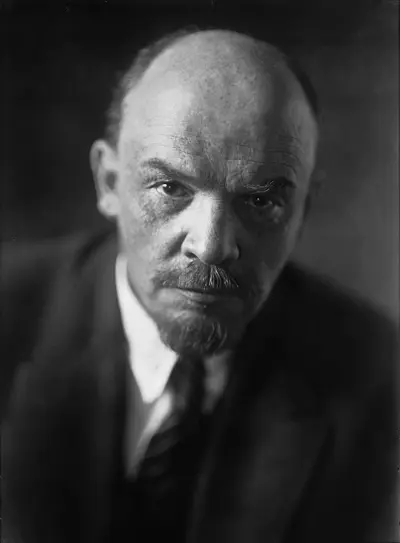
Vladimir Ilyich Ulyanov, better known by his alias Lenin, was a Russian revolutionary, politician, and political theorist. He served as the first and founding head of government of Soviet Russia from 1917 to 1924 and of the Soviet Union from 1922 to 1924. Under his administration, Russia, and later the Soviet Union, became a one-party socialist state governed by the Soviet Communist Party. A Marxist, he developed a variant of this communist ideology known as Leninism.
