Henry A. Kissinger Quotes
Taiwan will probably not declare independence. The question isn't independence. The issue is whether Taiwan will declare itself as a sovereign separate state. That will start a huge crisis if that happens.
Kissinger, Henry. Interview with Charlie Rose. PBS, 2007.

This quotation illustrates a huge reversal of policy. When Chiang Kai-shek and the Nationalists were defeated by the Communist Chinese in the Civil War, the Nationalists retreated to the island of Formosa (Taiwan) which was the only Chinese Province they held. There was the thought of setting up a separate nation on Taiwan, but Chiang Kai-shek and the Nationalists insisted that there was only one China and that they were the rightful government. At the time they held the Chinese UN Seat. The Communists also insisted that there was one China and Taiwan was a part of it with the Nationalists there being rebels. Chiang Kai-shek maintained that the people really wanted the Nationalists and they could take back the mainland. That turned out to be unrealistic and then the UN seat was given to the Communists as they were the de facto government of all of China except the province of Taiwan. There was nothing that the Nationalists and Communists agreed upon except that there was one China and Taiwan was a part of it. That, and the request of the Nationalist Chinese, has been the U. S Policy for decades. However by the 21st century, it was clear, even to the most fervent Nationalists, the Chinese Communists had won the allegiance of the majority of the Chinese people and they were not going to be successful in mounting a counter-revolution. Moreover, the Communist Military was much superior and some of the Nationalists started worry that Taiwan would be governed by the Communists along with the rest of China, So Lu and other Nationalists, flip flopped and took the position that Taiwan was an independent country—a view that is not recognized by the U. S. or China.


The document was signed in his name by his ministers.


Hobson, like Mark Twain in America, was a major critic of imperialism.


Arguing that the Arabs will never agree willingly to a Jewish state:


The state tried to nullify a Federal law in the early part of this ordinance {592185}. In this latter part South Carolina threatened to secede if the Federal Government were to try and enforce the tariff. This was their first threat of secession. They did not go through with it, but over 30 years later were the first Southern state to rebel and secede from the Union, The protectionist tariff was instituted to support American domestic manufacturers from competition from England and the rest of Europe. America then was an emerging underdeveloped country, but it would not take too long before America developed the best manufacturing in the world. The South was generally opposed to the tariff as they had little manufacturing to protect, and because of their slave labor system was not interested much in manufacturing, but since they had to pay more for manufactured items, they opposed the tariff. Also the maritime ports of New England who lost the shipping trade from Europe were opposed. Generally the rest of the country favored it. To compromise, the Jackson administration lowered the tariff slightly, but that did not satisfy the opponents, who continued to fight it.

The Texans wanted independence from Mexico and this quotation illustrates their three possible alternatives. Most Texans wanted to join the United State, but the United States was not very enthusiastic about having Texas. In a sense, Texas was made up of the malcontents, failures and riffraff from the United States. Many felt the nation was good to be rid of them. So initially, Texas was an independent republic. However, public and elite opinion began to change, and finally Texas was admitted.

This was the first official act of any state in declaring independence from England. On July 4th---almost 3 months later---Congress issued the Declaration of Independence. But North Carolina had taken the first official step.
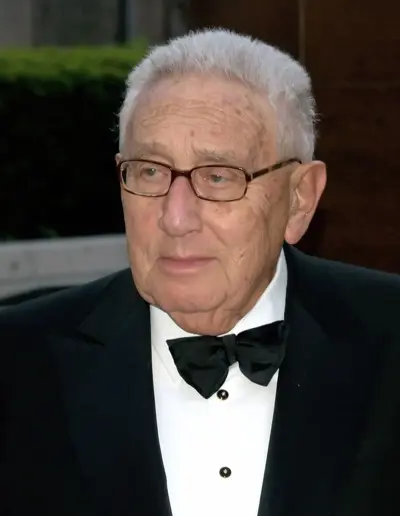
Henry Alfred Kissinger KCMG is an American politician, diplomat, and geopolitical consultant who served as United States Secretary of State and National Security Advisor under the presidential administrations of Richard Nixon and Gerald Ford. A Jewish refugee who fled Nazi Germany with his family in 1938, he became National Security Advisor in 1969 and U.S. Secretary of State in 1973. For his actions negotiating a ceasefire in Vietnam, Kissinger received the 1973 Nobel Peace Prize under controversial circumstances, with two members of the committee resigning in protest.
