Chen Shui-bian Quotes
Taiwan is an independent sovereign country.
Chen, Shui-bian. "Transcript: Chen Shui-bian Interview." BBC News, British Broadcasting Corporation, 30 Mar. 2004.

This quotation illustrates a huge reversal of policy. When Chiang Kai-shek and the Nationalists were defeated by the Communist Chinese in the Civil War, the Nationalists retreated to the island of Formosa (Taiwan) which was the only Chinese Province they held. There was the thought of setting up a separate nation on Taiwan, but Chiang Kai-shek and the Nationalists insisted that there was only one China and that they were the rightful government. At the time they held the Chinese UN Seat. The Communists also insisted that there was one China and Taiwan was a part of it with the Nationalists there being rebels. Chiang Kai-shek maintained that the people really wanted the Nationalists and they could take back the mainland. That turned out to be unrealistic and then the UN seat was given to the Communists as they were the de facto government of all of China except the province of Taiwan. There was nothing that the Nationalists and Communists agreed upon except that there was one China and Taiwan was a part of it. That, and the request of the Nationalist Chinese, has been the U. S Policy for decades. However by the 21st century, it was clear, even to the most fervent Nationalists, the Chinese Communists had won the allegiance of the majority of the Chinese people and they were not going to be successful in mounting a counter-revolution. Moreover, the Communist Military was much superior and some of the Nationalists started worry that Taiwan would be governed by the Communists along with the rest of China, So Lu and other Nationalists, flip flopped and took the position that Taiwan was an independent country—a view that is not recognized by the U. S. or China.


Although opposed to monarchy himself, Langdon argued that a people had a right to select monarchical government if they chose. See {634001} for Rev. Dan Foster’s similar argument at in that period.

French Canadian separatists had begun a movement for an independent Quebec. The area that was to be an independent nation, however, included the land of several Indian tribes including the Cree. They insisted on the same right of self-determination within Quebec as the French Canadians claimed within Canada. Their opposition among others led to the failure of the Meech Lake Accord.


The United States was opposed to elections at the beginning of the Vietnam war. The Viet Min, the Russian and Chinese recognized government of Ho Chi Min, was extremely well organized as a result of their cohesive organization and victory over the French Colonialists. At the urging of the French, we supported the previous Vietnam Emperor who the French had supported. However his popularity was limited to Saigon and French Colonial centers. The majority of the population saw him as the collaborator who was propped up by the hated French. There was no way that the Communist Viet Min would lose in an election. There had been no time for the people to see what peacetime living under the communists was like, and what they knew of the Emperor, they did not like. It was important to keep Vietnam from falling into the hands of the Communists. Once they won one election they would control the machinery of government to be sure that they won all subsequent elections even if the people wanted a change in government. The German newspaper thought that we should stick to our principles and allow a free election and live with the consequences. In retrospect, we would be where we ended up anyway with the Communist Viet Min in totalitarian control of the country and we would have saved many lives and much money.


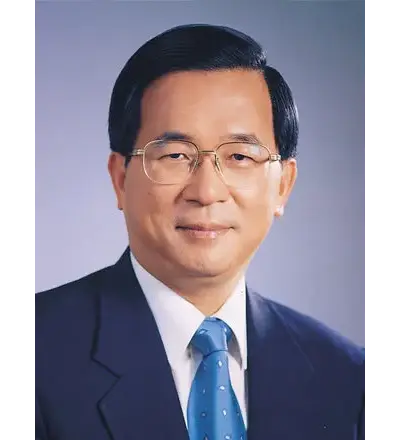
Chen Shui-bian is a retired Taiwanese politician and lawyer who served as the fifth president of the Republic of China (Taiwan) from 2000 to 2008. Chen is the first president from the Democratic Progressive Party (DPP) which ended the Kuomintang's (KMT) 55 years of continuous rule in Taiwan. He is colloquially referred to as A-Bian (阿扁).
