Bartolome de las Casas Quotes
[Spaniards] made bets as to who would slit a man in two, or cut off his head at one blow; or they opened up his bowels. They tore the babies from their mother’s breast by their feet, and dashed their heads against the rocks … They spitted the bodies of other babes, together with their mothers and all who were before them, on their swords. They hanged Indians by thirteens, in honor and reverence for our Redeemer and the Twelve Apostles …. They burned the Indians alive …. All this did my own eyes witness.
Bartolome de las Casas, 1474-1566, Catholic Priest, Historian Conquistador, History of the Indies, 1552
Sourced by: Eigen's Political and Historical Quotations


Jinnah and other Muslim leaders had stirred up the Muslims to violence to put pressure on all the parties to accede to Jinnah's Muslim League's demand of an independent Muslim nation—Pakistan. Messervy was very sympathetic to the Muslim leadership as he had been feuding with and frustrated by the predominantly Hindu ruling Congress Party. After partition he accepted the mercenary position of Commander in Chief of the Pakistani Army. Then he was shocked and horrified at the slaughter of the terrorist attacks by the Muslims—about 4,000 Sikh men, women and children had been beaten and cut to death. The Sikhs had been targeted largely because Sikh leaders had recently announced that if there were a Partition, Sikhs would refuse to live in nation under Muslim control.
First Published American Indian Author. His last public speech. He was referring to a horrible massacre of Christian Indians and the polarizing effect that such conflicts had. Whosoever publicly castigated a massacre of whites or Indians would be met by accusations of condoning the massacres of the other side and ignoring the inevitable and natural seeking of retaliation for future protection and revenge.


This quotation distressed many ultra rightists who otherwise were avid followers of Mises. See {632407} for another quotation that distressed many European conservative devotees of Mises.
This was part of the continual conflict between the Muslims and the Eastern Orthodox Christians. The Greeks ended up doubling their territory.
This argument—that Christians were more cruel and uncivilized than heathens in some respects was very persuasive to many serious white Christians who began to see slavery and the slave trade in a new light.


See Ferdinand I for the Bulgarian denial {601322}.
To this day there is a large stature of Montecino prominent in the skyline of Santo Domingo.

Lee was guilty but was also the scapegoat and was executed by the Army for his part in the Mountain Meadows Massacre. The inquiry stopped with his execution and exactly who wrote and approved Lee’s orders still is not known. Some believe that the authorities made a deal with the Mormon leadership. The Mormons gave up Lee, and the investigation stopped there.

The French refer to it as the Jacquerie since Jacques was a derogatory name for a peasant since so many men had that as a first name.
The U.S. was at war with Spain and Filipino insurgents for the control of the Philippines. During this war there were a few senior U. S. Officers who in later times would have been tried and jailed for war crimes. The men under them were brutal and committed atrocities at their orders. See {615368}.

Bangladesh was a part of Pakistan that was treated as a second class area by the Pakistan government. Some Bengalis in Dhaka demonstrated in protest and many were murdered by the Pakistani military and security forces. Rahman called on the government to right the situation. Nothing happened and finally Bangladesh revolted and gained their independence.


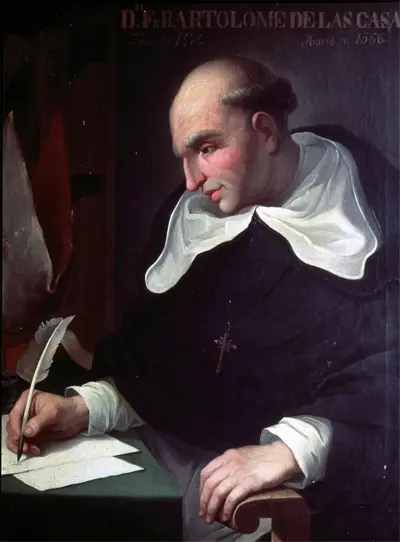
Bartolomé de las Casas was a 16th-century Spanish landowner, friar, priest, and bishop, famed as a historian and social reformer. He arrived in Hispaniola as a layman then became a Dominican friar and priest. He was appointed as the first resident Bishop of Chiapas, and the first officially appointed "Protector of the Indians". His extensive writings, the most famous being A Short Account of the Destruction of the Indies and Historia de Las Indias, chronicle the first decades of colonization of the West Indies. He described the atrocities committed by the colonizers against the indigenous peoples.
