W. Averell Harriman Quotes
Roosevelt was determined to stop Stalin from taking over Eastern Europe. He thought they finally had an agreement on Poland. Before Roosevelt died, he realized that Stalin had broken his agreement.
Harriman, W. Averell, and Elie Abel. Special Envoy to Churchill and Stalin, 1941-1946. Random House, 1975.


Many people mistakenly believe that this was the first political use of the “iron curtain” phrase—in German, “eiserner vorhang.” However, George Washington Crile used the phrase in 1915 {598870}. It is not known whether Geobbels knew of Crile’s work, or if Winston Churchill in his famous speech {411311} was familiar with either Crille’s or Goebbels use.


FDR was right about Russia being a major factor in stopping Hitler, but partially wrong about the danger of Russia. The Soviets never did dominate Europe although the tried, but they did dominate Eastern Europe.

At the time, the Red Scare was prevalent and many Americans were terrified of communists. It was a very effective political tactic to imply that an opponent was a communist or communist sympathizer. For another harsh smear of Stevenson, see {619523}.
Churchill put great store in personal interaction in diplomacy.

Harriman at that time was the United States Ambassador to Russia and one of President Roosevelt’s closest advisers. There were those who claimed that the Roosevelt administration was very naïve about the potential danger of Stalin. This statement as well as others like it, show that the administration was not so naïve and ignorant.


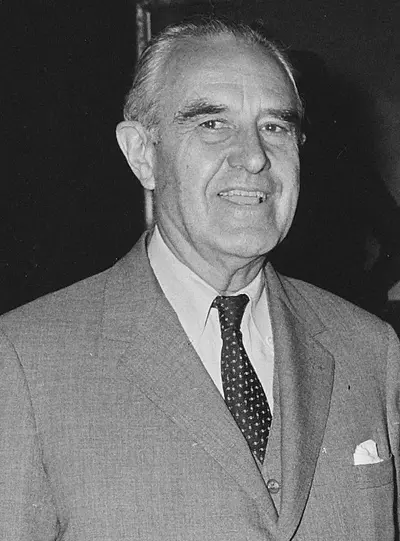
William Averell Harriman, better known as Averell Harriman, was an American Democratic politician, businessman, and diplomat. The son of railroad baron E. H. Harriman, he served as Secretary of Commerce under President Harry S. Truman, and later as the 48th Governor of New York. He was a candidate for the Democratic presidential nomination in 1952 and 1956, as well as a core member of the group of foreign policy elders known as "The Wise Men".
