Nikita Khrushchev Quotes
Even now we feel that Stalin was devoted to Communism, he was a Marxist, this cannot and should not be denied.
Khrushchev, Nikita. Speech at the Chinese Embassy. 17 Jan. 1957, Moscow. Reported in The New York Times, 18 Jan. 1957, p. 1.

Churchill put great store in personal interaction in diplomacy.

Seeger had joined the Young Communist League as a young boy, and was a supporter of Joseph Stalin until all the information about Stalin was made public by Russian Premier Nikita Khrushchev. Seeger, along with other Stalin apologists throughout the world realized that the criticisms of Russian Communism under Stalin were not just right wing propaganda.


Harriman at that time was the United States Ambassador to Russia and one of President Roosevelt’s closest advisers. There were those who claimed that the Roosevelt administration was very naïve about the potential danger of Stalin. This statement as well as others like it, show that the administration was not so naïve and ignorant.


Russia suffered enormous casualties in WWII where over 20 million Russians were killed. None the less, at the end of the war Europe was devastated with no viable economy. The fascist states and the democracies were all devastated. But Russia was still functioning. Instead of crediting the enormous Russian land mass, the success of the Russian Army, and the enormous amount of aid that the U. S. had provided, Stalin concluded that the reason was the Soviet Communist System.

He was a virulent anti communist and an opponent and foe of Chiang Kai-shek who he regarded as too moderate.

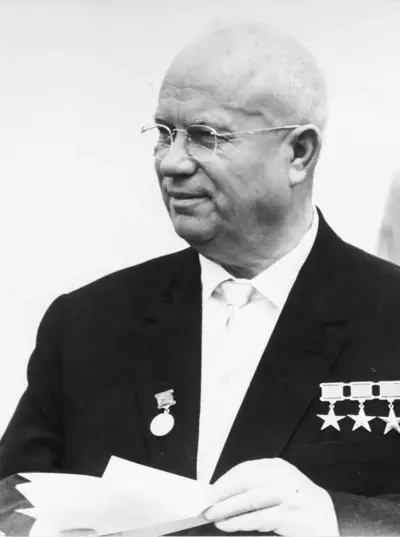
Nikita Sergeyevich Khrushchev led the Soviet Union as the First Secretary of the Communist Party of the Soviet Union from 1953 to 1964 and as chairman of the country's Council of Ministers from 1958 to 1964. During his rule, Khrushchev stunned the communist world with his denunciation of Stalin's crimes and began De-Stalinization. He sponsored the early Soviet space program, and enactment of relatively liberal reforms in domestic policy. After some false starts, and a near-nuclear war over Cuba, he conducted successful negotiations with the United States to reduce Cold War tensions. His proclivity toward recklessness led the Kremlin leadership to strip him from power, replacing him with Leonid Brezhnev as First Secretary and Alexei Kosygin as Premier.
