Peter Drucker Quotes
Reports tell you what your subordinates want you to know.
Peter Drucker, Management Expert, Interview, Wired 1996
Sourced by: Eigen's Political and Historical Quotations


Ironically it was the old Chinese culture of the Emperors where public official mistakes were generally paid for with the official’s life. However, there is a tendency the world over for the public to demand someone to be punished or fired. Often the easiest way for a politician with administrative responsibility to blunt that responsibility is to fire some subordinates or demote or otherwise punish them. In Taiwan they have a demerit system. The leader must take the responsibility for the failure. Many politicians (and business executives) observe that there are thousands of subordinates and that they cannot be held responsible for the errors that any of them make. While the do not want the responsibility, they are the first to claim the credit if anything goes right. If an employee should be fired, then do so, but as this quotation observes to meet out discipline in response to criticism is reprehensible.


Mrs. Nixon put her foot down and the West Wing did not thereafter control and manage the affairs and staff of the First Lady.

The business and financial institutions actually follow the statements and actions of an administration and its officials very closely, seeking “signals” of what action the government might take in the future. The actions that they take today may not become operational for several years (like building a new factory), so they try very hard to find out what the business and economic climate might be in the years to come. Sperling, like other very sophisticated economic advisers, realized that the President and his administration can often do little directly to influence the economy, but they can control what they say and the actions that they do take, to alter the perception of the economists, financiers, and business people throughout the nation.

Compare this quotation with {632899}. Most members of Congress had limited management experience and the only solution to an organizational problem was to fire people. The referenced quotation has people fired for the purpose of inspiring public trust; in this quotation, it is to trigger reform and change. Ironically, there is no evidence in the management literature that suggests that firing for either of these reasons will have the desired objective.

Compare this quotation with {632907}. Most members of Congress had limited management experience and the only solution to an organizational problem was to fire people. The referenced quotation has people fired to trigger reform and change; in this quotation, it is for the purpose of inspiring public trust. Ironically, there is no evidence in the management literature that suggests that firing for either of these reasons will have the desired objective.

In some areas the agencies even agree never to question or fight appropriation requests of the other and the President, Office of Management and Budget, and Congress is often presented with huge appropriations requests that other agencies never seem to have an criticism of. The Armed Services are notorious here. The Army will never criticize a new weapons system the Navy or Air Force wants nor will the Army ever argue that they could produce more with a different idea of their own. In return, the Army is never challenged by the other services in return just as Holbrook describes. In a sense, this has taken most of the competition for good ideas and the spending of public money out of the system and gives a modest amount to all regardless of need, worth, and public payoff.

Critics, pundits, and social and program evaluators, have—as Deleuze observes—a major vested interest in the outcome of the evaluations—namely their own economic and influential existence. That alone should cast suspicion on all evaluations,


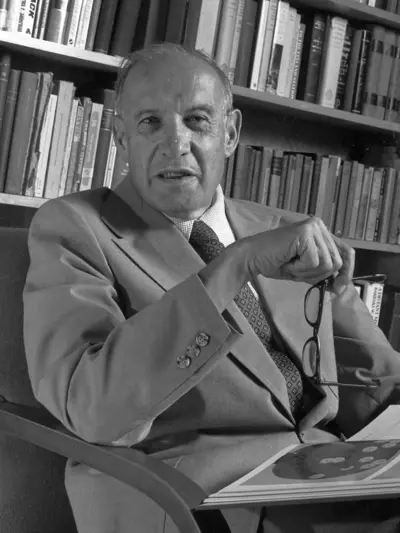
Peter Ferdinand Drucker was an Austrian management consultant, educator, and author, whose writings contributed to the philosophical and practical foundations of the modern business corporation. He was also a leader in the development of management education, he invented the concept known as management by objectives and self-control, and he has been described as "the founder of modern management".
