Paul D. Eaton Quotes
Our most important, and sometimes most severe, judges are our subordinates.
Paul D. Eaton, Army General, “For his failures, Rumsfeld must go!” International Herald Tribune, March 20, 2006
Sourced by: Eigen's Political and Historical Quotations

Coming to politics after a very successful career in business, Bloomberg lacked many of the typical politician’s skills, but was a superb manager of the city.


Compare this quotation with {632907}. Most members of Congress had limited management experience and the only solution to an organizational problem was to fire people. The referenced quotation has people fired to trigger reform and change; in this quotation, it is for the purpose of inspiring public trust. Ironically, there is no evidence in the management literature that suggests that firing for either of these reasons will have the desired objective.

Compare this quotation with {632899}. Most members of Congress had limited management experience and the only solution to an organizational problem was to fire people. The referenced quotation has people fired for the purpose of inspiring public trust; in this quotation, it is to trigger reform and change. Ironically, there is no evidence in the management literature that suggests that firing for either of these reasons will have the desired objective.

Ironically it was the old Chinese culture of the Emperors where public official mistakes were generally paid for with the official’s life. However, there is a tendency the world over for the public to demand someone to be punished or fired. Often the easiest way for a politician with administrative responsibility to blunt that responsibility is to fire some subordinates or demote or otherwise punish them. In Taiwan they have a demerit system. The leader must take the responsibility for the failure. Many politicians (and business executives) observe that there are thousands of subordinates and that they cannot be held responsible for the errors that any of them make. While the do not want the responsibility, they are the first to claim the credit if anything goes right. If an employee should be fired, then do so, but as this quotation observes to meet out discipline in response to criticism is reprehensible.


This quotation or parts of it are sometimes erroneously attributed to Albert Einstein.
Prior to this policy change, the Port Authority made and started to implement decisions and THEN held public hearings. The Port Authority is a bi-state organization that is the largest building authority in the country. It has built and operated all the bridges and tunnels connecting New York City Boroughs and the City with New Jersey and Long Island. They also have built and operated many of the major highways and recreation centers in New York City and Long Island. Additionally, it erects large buildings and other facilities like the World Trade Center. It’s funding comes directly from tolls, rents and other income from its facilities and the bonds that it floats, and so does not need any funding from either state. It actually makes a huge profit. It was started by Robert Moses, who wanted Independence of operation from the States of New Jersey and New York and the New York City Government. Moses was known for his authoritarian, non-consultative style, and subsequent Chairman tried to maintain that. Moses and the Port Authority had stayed clear of political influence and corruption. However, gradually the appointees were more and more beholden to the Governors of the two states and in 2014 a major scandal erupted where the New Jersey Governor’s staff was using the Port Authority to punish communities what did not support the Republican Governor Christie. This triggered calls for reform of which this new policy was one of the first.


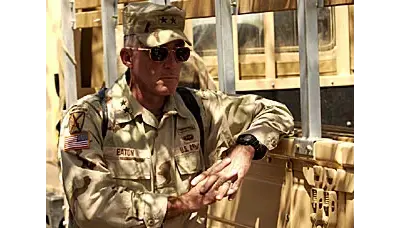
Paul D. Eaton (born 1950) is a former United States Army officer most known for his command of operations to train Iraqi troops during Operation Iraqi Freedom. Eaton served in that capacity between 2003 and 2004, and then returned to the US to become Deputy Chief of Staff for Operations and Training, United States Army Training and Doctrine Command, Fort Monroe, Virginia. He previously served as Senior Adviser to the now-defunct National Security Network, a progressive Washington, D.C.-based think tank that focused on foreign policy and defense issues.
