Seneca the Younger Quotes
Prudence will punish to prevent crime, not to avenge it.
Seneca, Lucius Annaeus. Moral Essays, Volume I. Translated by John W. Basore, Harvard University Press, 1928, p. 151.


He was one of the longest serving District Attorneys in America, He also served the largest jurisdiction of a District Attorney. When he first was elected DA of Manhattan there were over 600 murders a year. When he retired, there were only about 60, a 90% reduction. Yet, his experience was that capital punishment was useless in deterring murder. He had many other techniques far more effective.


Terror conceptually in France and some other countries was the tool the government used to inhibit criminals.


The most common example that capital punishment does not work as a deterrent is that while thieves were being hung for their crime, other thieves would circulate among the watching crowd at the scaffold and pickpocket the observers.


This has been the case in EVERY jurisdiction that has had capital punishment. Capital punishment does provide vengeance for victims, relatives and society. And in many societies execution is less expensive than prison for life. But it has never curtailed crime despite the example. In London, they used to have public executions as examples to inhibit crime. While the crowd was watching a pickpocket be hung, other pickpockets were relieving many spectators of their wallets and watches.


Our legal system tries to take the personal vengeance out of the law enforcement equation unlike for example Saudi Arabia where relatives get to personally behead the convicted murderer of one of their family. Rosenbaum and a few others claim that our system I not emotionjally and naturally satisfying.


There was, and still is in some parts of the world, this belief taht one of the main reasons for capital punioshment with visible and public executions was to deter others from comitting crimes by seeing the example of what happens to the transgressors. For these people, exemplified by this quotation of Dr. Johnson's, public executions are crime prevention. This notion tirned out to have been a fallacy. In England they found that during every public hanging, skilled pickpockets would steal from the onlookers who were tranfixed on the macabre secene--this despite the fact that pickpocketing was a hanging offence.


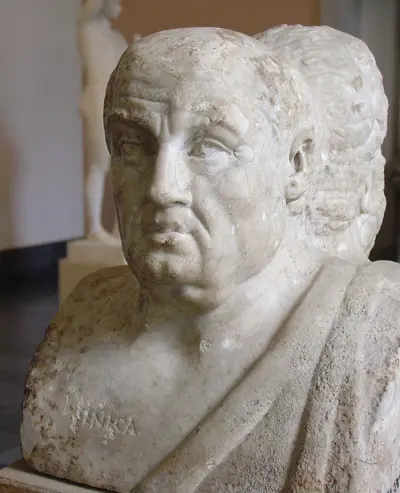
Lucius Annaeus Seneca the Younger (/ˈsɛnɪkə/; c. 4 BC – AD 65), usually known as Seneca, was a Roman Stoic philosopher, statesman, dramatist, and in one work, satirist from the Silver Age of Latin literature.
