Ali Khamenei Quotes
Progress and development of the Bahai community shall be blocked
Iran has been a terrible persecutor of Bahais, their largest religious minority. The Bahai faith was an offshoot of Islam which opposed to the concept of a theocracy and in a political sense at are the opposite end of the religious spectrum from Islam. Bahai in Iran are not allowed to attend higher education institutions, build religious facilities, preach openly or serve in many roles. Many have been executed on the spot by government officials, and others have been murdered by mobs. The radical Islamic justification of these murders lies with the relative intolerance Islam has for other religions. At the inception of Islam, the Prophet preached respect for People of the Book, which included Jews and Christians. He also made exception for Zoroastrians—the pre-Islamic traditional religion of Iran. These were not executed for heresy although they were never allowed to function on an equal footing with Islam. The harshest penalties were reserved for Muslims who abandoned their faith and converted or became atheists—it was death. They were allowed to repent and repudiate their new beliefs and there would be lesser punishments. But if they did not, they were executed. It is much the same logic of the Romans requiring early Christians to renounce their new religion or die in the arena or otherwise. Bahai grew out of Islam and is in many ways a type of reform movement within Islam. The initial torture and execution of the heretics, was not very different from what the Roman Catholic Church and its Inquisition did with Protestants. Some argue that historically Islam is 700 years behind Christianity. In the Middle ages the Christian Church killed non believers and heretics. However, by modern standards, this behavior of Iran and some other Islamic countries is as barbaric and evil as anything could be. The Bahai happen to be the greatest victims these days. See {614912}.
Ali Khamenei, Iranian Cleric & National Leader, (Under the Iranian Theocratic Constitution he is the virtual Dictator of Iran.), Order of the Supreme Revolutionary Cultural Council, ~1993
Sourced by: Eigen's Political and Historical Quotations

See {624641} for Iranian confirmation of its discriminatory policy. The Iranian "justification for murdering Bahais is this: The Behai were originally Muslims and then they created an heretic form of Islam. Under Islamic Law (Sharia), any Muslim who converts away from Islam to ANY other religioun must be out to death. As barbarous as this sounds, the irrational thinking is the same as that of the Catholic Church when Protestant chiurches emerged. All of them were to be put to death. However that was over 600 years ago, and humanity has much imporoved standards today. But the Muslims are 700 years younnger than the Catholic Church and some point out that they are behaving the same way as the Catholics, brutal as it is, when the Church was at the same level of maturity as Islam is today.


This verse has been one of the bases of Muslim theocratic states like Iran’s claim to legitimacy. The word “govern” is sometimes translated as “judge.” In the context of the 6th century, there were no separation of powers as we know them and judging, governing and legislating were melded.


This quotation which appears absurd on the surface given Iran’s terrible record with religious minorities provides insight to Islamic orthodox thought. For the orthodox Muslim, Sharia—Koranic Law—is the basis of the society. God defines the rights of people and their obligations. Whatever rights are provided by Sharia, Khomeini and some others wished to provide them equally to religious minorities also. However, those rights do not include the right to criticize the Islamic law or the leaders who implement it. That would be heresy if done by a Muslim, a Christian, or a Jew. A Christian church may not erect a public cross or ring bells on Sunday. That is prohibited by the Koran and is imposed on all. Bahai religious adherents are tracked down in the Islamic Republic and are often executed. ‘What about their rights?’ they ask. The answer is that the Bahai were Muslims who have become “backsliders” and heretics, and under Sharia, they must be executed for heresy; they are deemed to be heretical Muslims and not members of a minority religion.


by the House of Saud


Husayn Ali Nuri. The Persians executed Bahai as they considered these new religionists as Muslim heretics and Sharia—Islamic law—specified the death penalty for all the Muslims who convert or try and change the religion. After the Iranian revolution with the downfall of the Shah, the practice of executing Bahai in Iran was continued.

The King Outlawed Protestant Worship.
Husayn Ali Nuri. This quotation illustrates one of the reasons that the Muslim Iranian fundamentalists are so fearful of Bahai, a reform offshoot of Islam. For the orthodox Muslim there must be no separation of church and state—they are one and the same. The Bahai minority of Iran have been hunted down and in many cases killed on the grounds that they were heretics and blasphemers.
The Protestants had been given the right to practice their religion free from harm by the King’s grandfather. See {617664}. The inter-religious animosity continued and the Catholics again tried to make France an exclusively Catholic country.

Bashir advocates adapting Sharia—Islamic Law—for all people in Indonesia—regardless of their religion or their preference for separation of church and state. This is diametrically opposite to an Islamic Syrian poet of 1000 years ago—see {624477}. Many Muslims have become more intolerant than some of their earlier scholars. Bashir also differs from most Indonesian Muslims who have historically not shared his bigotry and intolerance.
Note that Khomeini realized that America assisted Saddam Hussein. We ended up being the enemy of both.

Ingersoll was considered to be the greatest orator and political thinker of his day, but his overt atheistic views curtailed his elected political career.

This quotation illustrated the extreme polarization between the current fundamentalist Muslims, and the Muslim modernists and the West. Kamal Ataturk, the great leader and stateman who is the father of modern Turkey, is castigated by the author for leading the new Turkish parliament to depose the Caliph – the civil and religious autocrat, one of whom reigned from after the death of Muhammad till his abolishment in 1924. Most of the rest of the world credits Ataturk with being one of the great leaders of all time—one who led a democratic revolution which transformed Turkey into the only Muslim secular democracy, requiring pubic secular European type education for all children, giving women the right to vote (before the U. S. even), adopting a European alphabet and dress, and outlook on life—creating most remarkably a total cultural revolution with virtually no loss of life. No revolutionary leader, before or since has led so extensive a political and cultural revolution, and it was a bloodless revolution. Turkey, into the 21st century, was by far the most powerful, industrialized, scientific and modern nation of Muslims in the world and others were far behind. Yet many Islamic theologian still castigate Atatork for his great achievements as being against the will of God.
This is the philosophical root of Islamic Fundamentalist terrorism. If this principle is accepted, then it is very easy to rationalize anything to change a situation where Islam and Islamic law does not control anywhere

Odo of Chatillon-Sur-Marne. This is an amazingly distressing quotation for most moderns. Here we have the Pope preaching genocide and ethnic cleansing. This was one of the main triggers of the bloody Crusades and is not forgotten by Muslims in the Middle East Today. As Islam has not changed a great deal in 1000 years, most Muslims assume that the same is true of Christianity and especially the popes and the Roman Catholic Church. This is one of the reasons that the Islamic world reacts so strongly when a pope makes any statement negatve about Muslims and Islam.
Also inscribed in gold around the Dome of the Rock. This was the most overt statement against Christianity and the Trinity in the Koran.
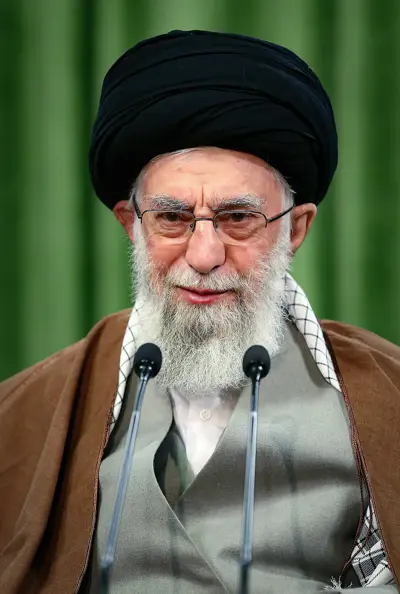
- Born: July 16, 1939
- Nationality: Iranian
- Profession: Statesman
Sayyid Ali Hosseini Khamenei is a Twelver Shia Marja' and the second and current supreme leader of Iran, in office since 1989. He was previously President of Iran from 1981 to 1989. Khamenei is the longest serving head of state in the Middle East, as well as the second-longest serving Iranian leader of the last century, after Shah Mohammad Reza Pahlavi.
