Ashfaq Parvez Kayani Quotes
Please provide continuous Predator coverage over anti-government militants.
While some Pakistani officials were publicly condemning the U. S. Drone Program, others privately asked for more use of the drones for intelligence purposes. This was provided. The Pakistan military was split. The regular army leaders saw the Taliban as a danger to the state; the ISI (intelligence service) supported the Taliban as they saw them as an ally against India.
Ashfaq Parvez Kayani, Pakistani Army Chief, Secret Request of the United States Authorities, 2008
Sourced by: Eigen's Political and Historical Quotations

The key security organizations of the Pakistan government had large numbers of radical Islamicists with great sympathy and close ties with the Islamic terrorists.


Many of the Pakistani leaders publicly opposed and complained about the Drone program, while privately they supported it and in some cases even requested drone strikes. In this case the Prime Minister would lead a protest against the Drone program in the National Assembly and then let the issue drop.


The Pakistani Government at the time and for most of the history of that nation did not have much control over the military, and regardless of what agreements the civilian government might have made, the military did not wanted to curry favor with as many Islamic radical terrorist groups as possible even though they even killed Muslims of Pakistan. They would not send the military into Northern Pakistan (Waziristan) to eliminate the Taliban sanctuaries or offend their tribal "hosts" as they were so paranoid about India that they wanted the terrorists as allies.
Inspire Magazine was the official propaganda magazine of Al Qaeda.


He had continuously been accused of not going after the infamous terrorist who people were suspecting was hiding in Pakistan. The President had heard these reports but maintained that he did not know where bin Laden was. On this occasion he challenged his challenger.


In 1927 Astor with other wealthy Americans (including Kermit Roosevelt, Marshall Field III, David Bruce and Winthrop Aldrich) founded their own private espionage agency, ROOM, which was utilized heavily by FDR:


The military attack on the Taliban was a great success and the regime was ousted very rapidly. Once the regime was displaced, however, the military was faced with an extremely decentralized country with sporadic resistance from Taliban sympathizers and with the tough task of rebuilding the dilapidated country.
36 days later, September 11, he did strike, and at the World Trade Center. The memo was kept secret by the Bush administration until public pressure as a result of the 9-11 Commission hearings forced the declassification and release. At that point it became clear that there was no reason that the memo could not have been released much earlier except that it was embarrassing.
36 days later, September 11, he did strike, and at the World Trade Center. The memo was kept secret by the Bush administration until public pressure as a result of the 9-11 Commission hearings forced the declassification and release. At that point it became clear that there was no reason that the memo could not have been released much earlier except that it was embarrassing.

In the War on Terror, some CIA officers had gotten a George W, Bush Administration green light to torture some captured terrorists using a torture technique known as “water boarding”—a practice for which American military personnel were court marshaled and convicted in the Philippine War. The torture sessions had been videotaped, a normal procedure with CIA interrogations. The fact of the torture had leaked and a national scandal ensued with Americans on both sides of the question. President Bush and his Vice President publicly stated that the United States does not torture. Rodriguez then ordered the tapes destroyed. Later he gave his reasons after the Obama Administration decided not to investigate the matter or determine which, if any, CIA officials might have broken the law, by wither doing the torturing or destroying evidence—“obstructing justice.”
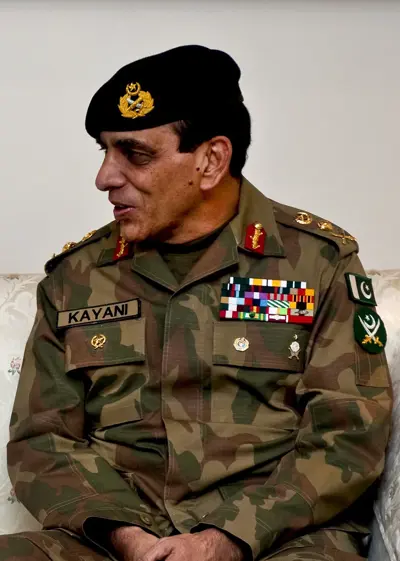
General Ashfaq Parvez Kayani, NI(M), HI(C), LOM, is a retired four-star rank army general in the Pakistan Army who served as the Chief of Army Staff (COAS), being appointed on 29 November 2007 until 29 November 2013.
