Malala Yousafzai Quotes
The Taliban has not really studied Islam…They only know jihad and fighting… they are using the name of Islam for their purposes
Most Islamic fundamentalists oppose the education of girls. Malala Yousafzai as a teen ager spoke out encouraging girls to go to school. This offended some of the Taliban fundamentalist terrorist, who threatened her if she continued to speak out. When she continued, they tried to murder her. They shot her in the head, but she was airlifted for medical treatment and survived. She was the winner of the European Sakharov Prize for Freedom of Thought and nominated for the Nobel Prize.
Malala Yousafzai, Pakistani Women’s Rights Activist, Interview, PBS Evening News, October 12, 2013
Sourced by: Eigen's Political and Historical Quotations

“Martyrdom” is the euphemism that fundamentalist Muslims use to denote being killed while “fighting for Islam” or on a suicide mission for same. Many believe that such people ascend directly to Paradise where they are given a bevy of virgins and other “perks.” Ironically, this was the last interview that he gave before he himself was “martyred”—he was killed by coalition troops. This mental perspective is one of the reasons that fighting fundamentalist Islamic terrorists is so difficult. They perceive victory whichever way the battle or even the war comes out.


After years of minority Sunni Muslim rule of Iraq, the U. S. invasion gave the majority Shiite Muslims political control. The Sunnis and Shiites have been at each others throats for centuries despite the fact that they are both Muslims. Saudi Arabia is the center of Sunni Islam and many of its religious extremists issue edicts advocating the suicide bombing of Shiite mosques and other facilities and assuring martyrdom for the suicide bombers.


This quotation illustrates the dissentions that exist between the various Islamic terrorist organizations. The Secretary General of Hezbollah herein castigates the rival and more religiously fundamentalist Al Qaeda for killing innocent Muslims. Not only do neither mind killing innocent people who are not Muslims, but Hezbollah indiscriminately fires rockets into Israeli populated areas and has killed innocent Muslims, Christians and Jews. Further, Hezbollah will force Muslim citizens of Lebanon to store arms and allow rocked firing from their properties and institutions like schools, mosques, and hospitals, knowing perfectly well that they minute they do this, under the Geneva conventions, those homes or institutions become a legal target for retaliatory attacks, artillery, air strikes or ground forces and that innocent Muslim civilians would be killed. The levels of terrorist subtlety is difficult for Westerners to comprehend.

A Fatwa is an Islamic theological legal ruling. Islam has no hierarchy. So this Fatwa is not necessarily binding on any Muslims who do not wish to be bound by it. This is one of the relatively few Islamic theological organizations who have taken a public stand against terrorism.


Slogans taken from posters listing 10 people targeted by Muslim extremists. Most were people who had said or published material that some fundamentalist Muslims had decided were offensive to Islam. One was Charlie Hebdo, the French Publisher who Islamic terrorists murdered later. Note the Americanisms that the terrorist propagandists adopted. The Wanted Dead or Alive was taken from the posters of the American West of the 19th century. The "Yes we can" was lifted from the Barack Obama 2008 campaign slogan. The "Bullet A Day Keeps the Infidel Away" is a takeoff on the American saying "An apple a day keeps the Doctor away." One of the reasons for these Americanisms was that the founding editor was Samir Khan, self-described American traitor.

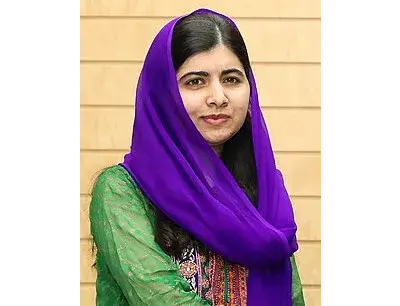
Malala Yousafzai, often referred to mononymously as Malala, is a Pakistani activist for female education and the youngest Nobel Prize laureate. She is known for human rights advocacy, especially the education of women and children in her native Swat Valley in Khyber Pakhtunkhwa, northwest Pakistan, where the local Pakistani Taliban had at times banned girls from attending school. Her advocacy has grown into an international movement, and according to former Pakistani Prime Minister Shahid Khaqan Abbasi, she has become "the most prominent citizen" of the country.
