Adam Smith Quotes
People of the same trade seldom meet together, even for merriment and diversion, but the conversation ends in a conspiracy against the public, or in some contrivance to raise prices. It is impossible indeed to prevent such meetings, by any law which either could be executed, or would be consistent with liberty or justice. But though the law cannot hinder people of the same trade from sometimes assembling together, it ought to do nothing to facilitate such assemblies; much less to render them necessary.
Smith, Adam. An Inquiry into the Nature and Causes of the Wealth of Nations. W. Strahan and T. Cadell, 1776.


This volume roughly is to Islam what the Gospels are to Christianity. To most Muslims The Sunnah is a collection of holy material on the life of Mohammed. It is not of the force or importance as the Koran, but it is revered.

Brandeis was U. S. Supreme Court Justice Louis D. Brandeis, 1856-1941, who wrote that competition would control prices if only healthy competition could be maintained—the problem was resolved by both increasing competition and much more stringent regulation of corporations.


He was referring to the accusations that the Donald Trump Campaign Staff had colluded with the Russians in 2016 and 2017. Senior members of the Trup Staff including his Campaign Manager and his son Donald Trump Jr had met with Russian agents to get damaging information about Trumps opponent. Trump staff had claimed that there was nothing wrong because the didn't get anything useful.


See {642189} where Sherman explained some of the reasons for the law.
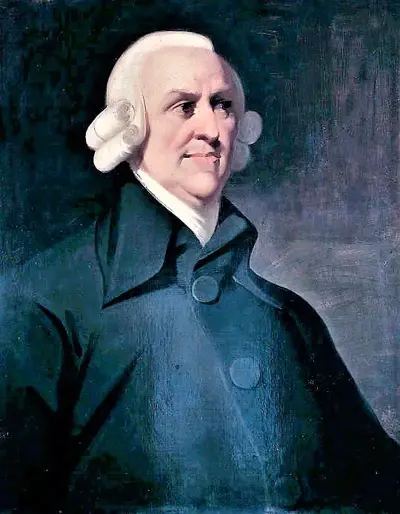
Adam Smith FRSA was a Scottish economist, philosopher as well as a moral philosopher, a pioneer of political economy, and a key figure during the Scottish Enlightenment, also known as ''The Father of Economics'' or ''The Father of Capitalism''. Smith wrote two classic works, The Theory of Moral Sentiments (1759) and An Inquiry into the Nature and Causes of the Wealth of Nations (1776). The latter, often abbreviated as The Wealth of Nations, is considered his magnum opus and the first modern work of economics. In his work, Adam Smith introduced his theory of absolute advantage.
