John Stuart Mill Quotes
Panics do not destroy capital; they merely reveal the extent to which it has been previously destroyed by its betrayal into hopelessly unproductive works.
John Stuart Mill, 1806-1873, Member of Parliament, British Political Economist 1867
Sourced by: Eigen's Political and Historical Quotations


Essentially Mellon told the President to let the entire economy crash. With huge numbers of people out of work, labor would be more humble and not only settle for lower wages, but will work harder, and without "excess" income beyond their basic needs, they would not drink and engage in other immoral activities. President Hoover, a wealthy man himself, did not go along with Mellon's idea of making the situation worse, but his conservative philosophy of government would not allow the Government to "interfere" with the private economy or give any direct assistance to the citizens.


He was one of the very few people who warned about the market crash of 1929 and the Great Depression.

When the Meltdown hit America, the crisis drew attention to the fiscal solvency and stability of banks in most of the world. The Irish banks were much more overextended than those of most counties and when that came to light there was a bank panic in Ireland. Ahern and the Irish Dail (parliament) decided to bail out the Irish bank at a very great cost to the rest of the Irish economy and people. He believed if Lehman Brothers had been bailed out, as America did with other institutions, the Irish bank bubble would not have burst. It is not known whether he actually meant to use the word “testicles” or he made a gaff intending to use the word “tentacles”. Both have relevant meaning in the situation with a significant shade of difference in meaning between the two.


Most people think that in a democracy, the government has more control over the economy than it really does as Hoover observed almost a century ago. However, the major issue between liberals and conservatives is whether or not the government should use the tools that it does have that might influence the economy and to what extent the government should ameliorate the damage that the poor and middle class suffers from the recession or depression. Unemployment insurance and food stamp distribution are basic examples of amelioration. When the Great Depression hit, Hoover was president and he chose not to use the powers of government and became America’s worst President at managing the economy.


Keynes thought that within 100 years, governments could control economies so that recessions and depressions would not tale place and a sufficient standard of living could be maintained so that poverty would be eliminated. By the end of the 20th century, no nation had accomplished this and few tried. By the 21st century, globalization made it impossible for a single nation or even a small group of nations to control a nation’s economy.

This was an honest theoretical belief of Mises. However, most of the criticism of capitalism in the industrial democracies is precisely the lack of unemployment and sustenance for all. When it does, even complaints about inequality tend to be minimal. But some capitalist societies never provided these, and by the 21st century, no capitalist nation was able to do so permanently without recessions and depressions.
The Grammar Curmudgeon
This is a classic illustration of a quotation illustrating the problem that political discussions have with the issue of causality. Conrad is absolutely correct in stating that investment and innovation as the direct cause for most productivity. However, without the demand created by consumption (or the prospect of it) there will be little capital and effort at innovation. There is a causal chain and different ideological proponents argue for their preferred link in the chain tending to ignore the other links. Many liberals tout increasing consumption and pay little attention to the investment and innovation—an error of the opposite of Conrad’s.

The great scholars were as wrong as everyone else about the Great Depression
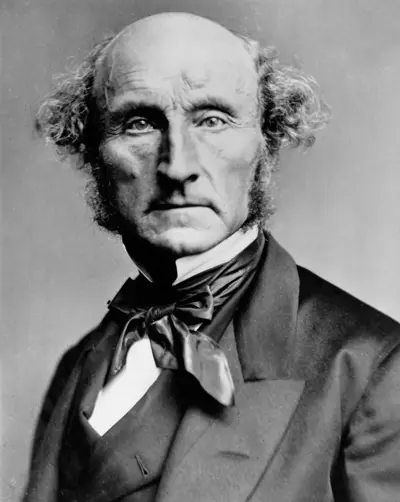
John Stuart Mill, usually cited as J. S. Mill, was an English philosopher, political economist, Member of Parliament, and civil servant. One of the most influential thinkers in the history of classical liberalism, he contributed widely to social theory, political theory, and political economy. Dubbed "the most influential English-speaking philosopher of the nineteenth century", he conceived of liberty as justifying the freedom of the individual in opposition to unlimited state and social control.
