Matthew Whitaker Quotes
Over the last few years, we have seen too many politicians disregard the Constitution as they voted to increase the size and scope of government. I will use my legal experience gained as a federal attorney to hold them accountable.
Whitaker, Matthew. "Matthew Whitaker Announces U.S. Senate Campaign." Whitaker for U.S. Senate, 7 May 2013.

On why the President should not be given the right to go to war without the approval of Congress:


Parliament had developed a formal mechanism of removing officials in extreme circumstances. It was borrowed for the U. S. Constitution. See {584256}.

President George W. Bush had ignored a federal law and tapped the phones of Americans without probable cause and a warrant issued by a court. The President’s defenders argued that the President, as Commander in Chief, has the Constitutional responsibility to lead the military and protect the nation. Intelligence gathering is part of military activity. Therefore the intelligence gathering is a Constitutional duty and the Congress, under the separation of powers doctrine, may not interfere with the President’s Constitutional Duty to conduct intelligence. Under this doctrine, the President need not obey laws that he believes impinge on his management of the war effort and the defense of the nation. Most legal scholars believe that this argument is nonsense, but the George W. Bush administration has stated the doctrine and it was the subject of much litigation.

Senator Grimes thought that Andrew Johnson was a terrible President, but when the House of Representatives impeached President Johnson and he was tried before the Senate, Grimes voted for acquittal. His reason for the his vote was he thought that the Constitution did not provide for the removal if a President just because he has “Unacceptable.” Johnson survived removal from office by a single vote and had Grimes not been so principled about the Constitution, Johnson would have been removed from office. On the other hand, Johnson was a terrible President and many of the nations racial problems in later years emanated from his actions and inactions while in office.


President George W. Bush, during the War on Terror, asserted the authority to contravene laws passed by Congress and signed by a previous president. He further, argued that he did not have to inform Congress when he ordered steps that broke the existing laws. His position was based on his claim that there were inherent Presidential powers in wartime granted by the Constitution and the Congress could not override the Constitution.


This was an insult to the George W. Bush administration which had stretched the Constitution more so than any previous administration, had asserted Presidential powers that had never been asserted before and had had several of its more controversial policies and practices overturned by the Supreme Court.

Powell was the Secretary of State and Addington kept advising the administration that as long as the President was acting in defense of the country in his capacity as Commander in Chief, he did not have to obey any existing laws that had been Constitutionally passed which in the opinion of the President restricted or limited the President or the executive branch. Addington was an attorney and Assistant to the Vice President, but he was given much responsibility for administration policy. Powell the Secretary of State of the Administration could not have disagreed more and although most politicians including Republicans disagreed with the Addington thesis, Powell was one of the few Republicans to criticize the Addington position.

The Congress over the last century has ceded much of its Constitutional power to the President. Congress has much power to check the President, but just as Congress has not been very competent at legislating, oversight, and conducting hearings and investigations, it has not organized itself to use the powers it has very well.


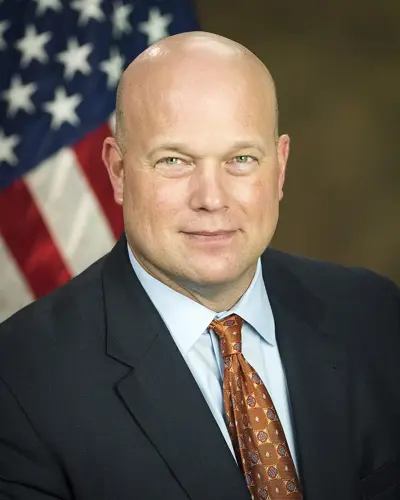
Matthew George Whitaker is an American lawyer, lobbyist and politician who served as the acting United States Attorney General from November 7, 2018, to February 14, 2019. He was appointed to that position by President Donald Trump after Jeff Sessions resigned at Trump's request. Whitaker had previously served as Chief of Staff to Sessions from October 2017 to November 2018.
