William E. Gladstone Quotes
Our first sight in Egypt, be it by larceny or be it by preemption, will be the almost certain egg of a North African Empire that will grow and grow until … we finally join hands across the equator with Natal and Cape Town.
William E. Gladstone, 1809-1898, British Prime Minister (Liberal), August 1877
Sourced by: Eigen's Political and Historical Quotations


Grey’s statement which had been made without any coordination with the Prime Minister, came to be called the “Grey Declaration,” and was the talk of diplomatic Europe. Grey claimed to be only talking about a hypothetical possibility, but the French actually had designs on the “other side” of Africa. They perceived that Grey was threatening war and referred to the declaration as the “fameuse manifestation.” The French sought and obtained a rapprochement and left the Niger valley to the British.

The Negro World, Garvey’s Newspaper, was the country’s largest Black newspaper. The statement brought great distress to white Europe whose colonial interests were threatened.


In contrast to Queen Victoria and the Conservative Government before him, Gladstone opposed most colonial expansionism. However, in a policy analysis that in later years would come to be called “the Domino Theory,” Gladstone felt compelled to put down the revolt.
The Gladstone government delayes and the force did not arrive on time. The town fell to the Madhi’s forces. Gordon was killed.

He was an Army Major at the time he wrote this article. In 1966 his positive view of Britain was overwhelmed by the anti-colonial fervor that existed in much of Africa.

The Turkish Ottoman Empire controlled most of the Middle East and at times Arab areas and tribes would revolt. Egypt was considered the prize of the Middle East. The Ottomans not only controlled the Middle East militarily and civilly, but also religiously. The Turkish Sultan was the spiritual leader of almost all of the Middle Eastern Muslims.


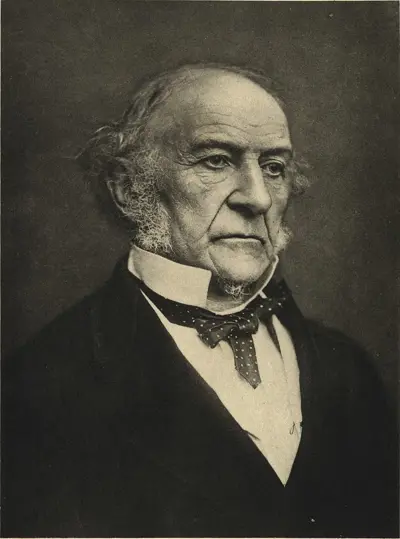
William Ewart Gladstone FRS FSS was a British statesman and Liberal politician. In a career lasting over 60 years, he served for 12 years as Prime Minister of the United Kingdom, spread over four terms beginning in 1868 and ending in 1894. He also served as Chancellor of the Exchequer four times, serving over 12 years.
