Hartford Convention Quotes
No person who shall hereafter be naturalized, shall be eligible as a member of the Senate or House of Representatives of the United States, nor capable of holding any civil office under the authority of the United States
There was much New England dissatisfaction with the disproportionate power held by the Southern states as a result of counting three-fifths of the slave population for apportioning Congressional seats. In addition they were disproportionately hurt by the War of 1812 and the Embargo on trade with England. Secession was proposed but failed to get a majority. A number of proposed Constitutional amendments were voted upon. This one reflected the racism and nativism of the time.
Hartford Convention, Convention of New England States, Proposed Constitutional Amendment, January 1815
Sourced by: Eigen's Political and Historical Quotations


Originally published as The Cynic’s Word Book


There was much New England dissatisfaction with the disproportionate power held by the Southern states as a result of counting three-fifths of the slave population for apportioning Congressional seats. In addition they were disproportionately hurt by the War of 1812 and the Embargo on trade with England. Secession was proposed but failed to get a majority. A number of proposed Constitutional amendments were voted upon. The super-majority herein required would have diminished their vulnerability to Southern power.
There was much New England dissatisfaction with the disproportionate power held by the Southern states as a result of counting three-fifths of the slave population for apportioning Congressional seats. In addition they were disproportionately hurt by the War of 1812 and the Embargo on trade with England. Secession was proposed but failed to get a majority. A number of proposed Constitutional amendments were voted upon. The super-majority herein required would have diminished their vulnerability to Southern power.

The first clause, the preamble, indicates the pressure that emanated from the State ratification conventions. Of the 12 amendments proposed, only 10 were ratified—The Bill of Rights. See {612693} for the two that did not get ratified.

Morris had it wrong. He perceived that the Senate could not be a check on the House or the President because to him, the Senate was the house of aristocrats and America really did not have aristocrats since there was no nobility so that there would be no difference between Representatives and Senators-–they both were drawn from the same egalitarian population. He missed however that the Senate, being elected by states, would represent a broader constituency than a member of the House, and because of this broader perspective, would come to see issues in nationalist and state terms while Representatives would perceive the same issues in local terms. Hence the two houses of Congress became effective checks on each other, and the Senate on the President because not of different social or economic class, but of broader and narrower perspectives. It was not what Senators were but what they would become once they were elected and had to be reelected.

Note that early constitutional experts assumed that one of the President’s roles was to be non partisan and control partisanship. Note the phrase ‘prevent the artifices of party’. The early founders were very wary of political parties of ‘factions’ as Madison called them. However, most were extremely partisan although in the Presidency partisanship was toned down by George Washington but after him, partisan ship became the norm.
This proposed Constitutional Amendment was debated just before Abraham Lincoln would take office. The South wanted to tie his hands on the Slavery issue, and wanted to end what had become a constant polarized Congressional debate over slavery. Of course, their idea of ending the debate was to Constitutionally prohibit further attempts to outlaw or otherwise interfere with slavery in the Southern states. A number of Northern members of Congress voted for it realizing that there was little or no chance of obtaining the ratifications of ¾ of the states and they wanted to buy some time for the Southerners to calm down over their fear of Lincoln and his upstart Republican party. The Amendment never obtained the needed votes though a few states did ratify it. Secession and the Civil War mad the amendment moot. The Southern position was so rigid, that they would compromise in no way on the slavery issue, and ended up of course losing more than they ever thought was possible by succeeding. Another reason this proposed amendment is historically important, is that it is yet another strong piece of evidence that the issue of the Civil War was slavery and not differences in political and economic philosophies as many Southerners have claimed since then. If States Rights in general were the great concern, would have been no reason to single out slavery if it were not the major issue. Yet the last phrase, “including that of persons held to labor or service by the laws of said State” does just. Similar evidence is given by the Secession Resolutions of the Southern States and the debates around them. It is clear that slavery was the issue that the South fought over.


This proposed Amendment would also have repealed the 14th and 4th Andmendments

She had just given birth and found out that there were archaic rules adopted by the Senate.


Under his leadership the conservative Republicans had attempted and failed dozens of times to repeal Obamacare which many Republicans campaigned against in the 2012 Presidential election which they also lost. The irony was that even if a repeal were to possibly pass both housed of Congress, President Obama announced that he would veto the repeal. This futile and repetitive wast of time took place where the House was so extreme that it originated almost no legislation that every became law. The conservative Republicans had opposed every attempt to provide a national health system since they blocked President Truman from it. Yet Medicare was passed and became one of America’s most popular programs. Conservatives blocked all efforts to expand Medicare to cover all Americans until President Obama in his first term passed Obamacare. Since then they made all these attempts to repeal it.


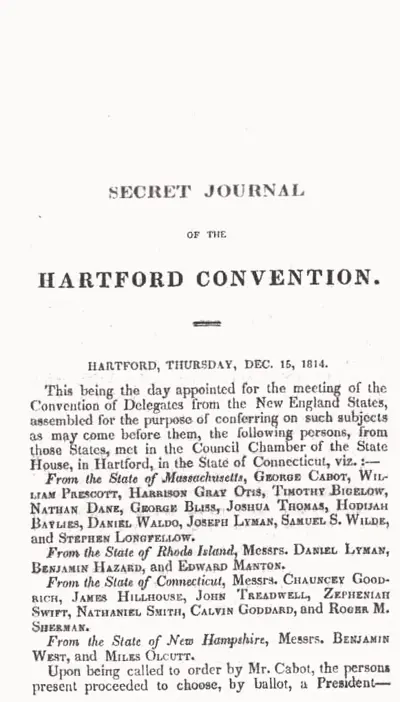
The Hartford Convention was a series of meetings from December 15, 1814 to January 5, 1815, in Hartford, Connecticut, United States, in which the New England Federalist Party met to discuss their grievances concerning the ongoing War of 1812 and the political problems arising from the federal government's increasing power.
