Hartford Convention Quotes
Congress shall not make or declare war, or authorize acts of hostility against any foreign nation, without the concurrence of two-thirds of both Houses, except such acts of hostility be in defense of the territories of the United States when actually invaded.
There was much New England dissatisfaction with the disproportionate power held by the Southern states as a result of counting three-fifths of the slave population for apportioning Congressional seats. In addition they were disproportionately hurt by the War of 1812 and the Embargo on trade with England. Secession was proposed but failed to get a majority. A number of proposed Constitutional amendments were voted upon. The super-majority herein required would have diminished their vulnerability to Southern power.
Hartford Convention, Convention of New England States, Proposed Constitutional Amendment, January 1815
Sourced by: Eigen's Political and Historical Quotations

In 1949 the NATO treaty was signed. There was concern that a phrase in the treaty authorizing signatories to take "such action as it deems necessary, including the use of armed force" would undermine Congress's powers:


When the Senate was debating the Gulf of Tonkin Resolution, which would empower the President to take "all necessary measures" to repel any armed attack on U. S. forces, Senator Morse was one of only two Senators opposing the resolution:


Vidal, a staunch liberal held this view along with many ultra conservatives end extreme liberals. The constitution requires the Congress to declare war, but they have not done so for any of the wars since WWII. The President assumed the war power. And the only coherent budgets began.


President Eisenhower was asked if there was any danger of the country getting inadvertently drawn into a war in Vietnam as the result of sending military "advisors":


An earlier version was written by Congressman Louis L. Ludlow, 1873-1950—see his quotation about it—{39681}. The proposed amendment was narrowly defeated.


There was much New England dissatisfaction with the disproportionate power held by the Southern states as a result of counting three-fifths of the slave population for apportioning Congressional seats. In addition they were disproportionately hurt by the War of 1812 and the Embargo on trade with England. Secession was proposed but failed to get a majority. A number of proposed Constitutional amendments were voted upon. The super-majority herein required would have diminished their vulnerability to Southern power.

President George W. Bush initiated an invasion of Iraq based on the fact that Iraq was developing nuclear, chemical and biological weapons. After the invasion however, there were none of these weapons found and much evidence that there were not any at that point in time. By the time Congress, the body which is supposed to declare war, found out that the reason for the war was bogus, it was too late. We had already occupied the country and were in the midst of a civil war. The President either acted on bad intelligence or wanted to invade Iraq for other reasons and history may finally tell us which, but Fein sees the problem as too much secrecy in the executive branch.


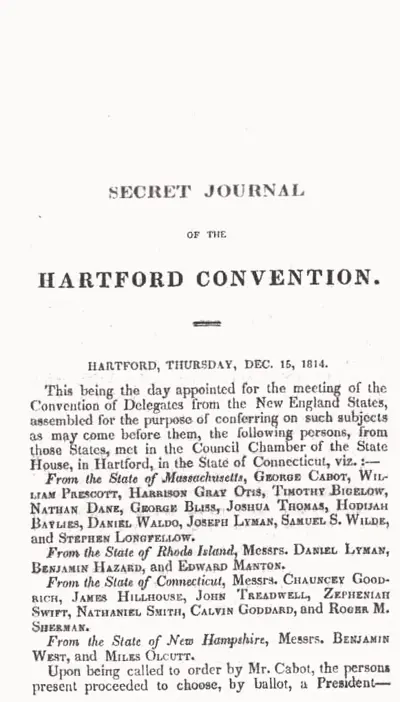
The Hartford Convention was a series of meetings from December 15, 1814 to January 5, 1815, in Hartford, Connecticut, United States, in which the New England Federalist Party met to discuss their grievances concerning the ongoing War of 1812 and the political problems arising from the federal government's increasing power.
