George H. Thomas Quotes
No no. Mix them up. I’m tired of States’ rights.
The custom during the civil war was that dead soldiers would be buried in groups by the state they came from. The chaplain, after a particularly bloody battle, has asked if he should separate the bodies by state.
George H. Thomas, 1816–1870 Union Army General, Statement to the army chaplain, Battle of Chattanooga, 1863
Sourced by: Eigen's Political and Historical Quotations

At the start of his first term Lincoln was supportive of States rights.


At the time his Vice President, John C. Calhoun, was expounding a theory of “nullification” by which the states could supersede and nullify federal law in their states. When Jackson finished his toast, it was Calhoun’s turn (See {635896}.) His toast supported the States’ Rights position over the federal government. In those days Presidents and Vice President’s were often political enemies or of opposite parties. The President’s advisors thought that his toast might be misinterpreted. So when they gave the toast to the press as “The Federal Union: It must be preserved.” That was the form in which the press reported the President’s toast and for many years that was the version most quoted even though it was never delivered that way. However Jackson was responsible for both versions.


Commonly referred to as the Kentucky Resolution. This concept of Nullification was one of the factors that aggravated the tensions leading to the Civil War. Were the individual States to be the arbiters of whether or not a Federal act was Constitutional or was it to be the Supreme Court.
Madison was defending the proposed Constitution against a vocal minority who complained that the Federal government would be dominant over the States and the large cities. Madison pointed out that it was people who fought the Revolution and sacrificed for it, not States or political entities. The Constitution was to be for the people, not the existing governmental entities. It was for Americans and not for local politicians. The “State’s Rights faction lost the debate, and the Constitution and Bill of Rights was adopted. That is why this quotation is so important. The slavery enthusiasts, racists, and others have constantly tried to diminish the Federal supremacy even to this day.
Jackson makes the case against the South Carolina argument for nullification. In the related quote, he makes his threat which was very successful in ending the notion of “nullification”. The extensive quotation is given as it summarizes the entire issue that was one of the crises of early America.

The Grammar Curmudgeon. In most states there is a parallel question of the State government and the local government balance of powers.
Whoever has the political control of the central government generally favors more centralized power and less decentralization. The opposition wanting to weaken the majority, tends to favor decentralization and states’ rights and the local governments.


Ironically, many Republican leaders give lip service to decentralized government but they fight hard for centralized national government making. Many want Congress to make laws governing abortion and other family planning techniques. Some want the state to decide, but almost no Republicans want to leave these personal decisions to the local government much less the family and women involved. In business regulation as well, republican fight tooth and nail to have Federal legislation prempt state and local government about tort liability for defective products, and they always prefer that the Federal SEC make all the rules and regulations about selling stocks and bonds and do not want state or local government to “interfere”. Likewise, they have emasculated the state governments when it comes to authority over the state militias where virtually all the controls and promotions are decided by Congress and the Department of Defense and not by Governors or local politicians. Ther are many other examples. In most of the solid Republican Southern States, the local school boards cannot even select the textbooks that schools will use and the Republicans centralize this with the State government and state legislatures which they control. Democrats also are generally opposed to decentralization except for large cities having control along with the Federal government but otherwise they too do not want decentralization. For national political parties, what is the point of winning national elections of the big decisions are made locally?
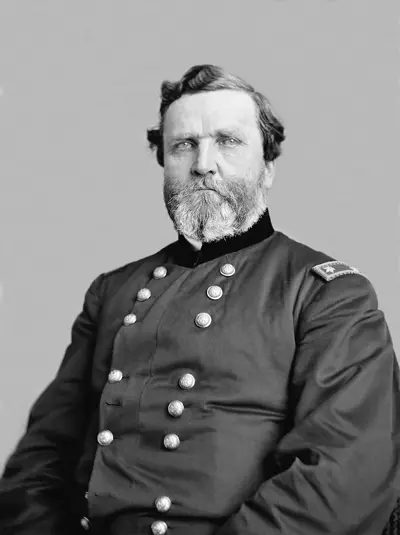
George Henry Thomas was a United States Army officer and a Union general during the American Civil War, one of the principal commanders in the Western Theater.
