William Jennings Bryan Quotes
No man can make a million dollars honestly.
William Jennings Bryan, 1860-1925, U. S. Secretary of State, U. S. Congressman (Democrat, NB), 3 Time Unsuccessful Democratic Presidential Candidate, Campaign Speech, 1896, Quoted on The History Channel, The Men Who Built America, November 2, 2013
Sourced by: Eigen's Political and Historical Quotations

The three richest men in America—John D, Rockefeller, Andrew Carnegie, and Morgan, usually major rivals—had gathered together to decide what to do about William Jennings Bryan, who they viewed as very hostile to business and capitalism. (See {641037} and {641038} for Bryan quotation examples that concerned them.) They agreed to combine their efforts and back William McKinley who was running for the Republican Presidential nomination. In those days, the nominee was chosen by a small group of party leaders and their resources guaranteed McKinley the post. They then put large amounts of money to campaigning against Bryan and for McKinley including dirty tricks, many of which are illegal today. It is not known for certain whether McKinley knew the extent of the involvement of the monopolists, but shortly after assuming the Presidency he cut back on many of the relatively few regulations that then existed to control unbridled capitalism. Their effort went for naught when McKinley was assassinated and Theodore Roosevelt became President. Roosevelt would not be bribed or intimidated, and he did more to control monopolies than even Bryan would likely have.


[This has the sound, textural and physical structure of a wonderful quotation. However it does not comport with reality. The second clause does, but the first is contradicted by many who have made money honestly and then had a revelation of one type or another. And then of course there are so many of the thinkers and philosophers who damn money but never earned much himself.]thinkers and philosophers who damn money but never earned much himself.]


Although England had benefitted more from the industrial revolution than most nations, the English Aristocracy and its intelligencia saw business as inherently corrupt with minimal ethical standards and almost no transparency. See {629121} for a Christian religious version of this secular quotation.


See {640733} for an English political leader’s similar view.


Hearst was running for New York governor. A Wall Street emissary offered him a $100,000 campaign contribution if the candidate could assure him that his views were reasonable towards honest businesses:


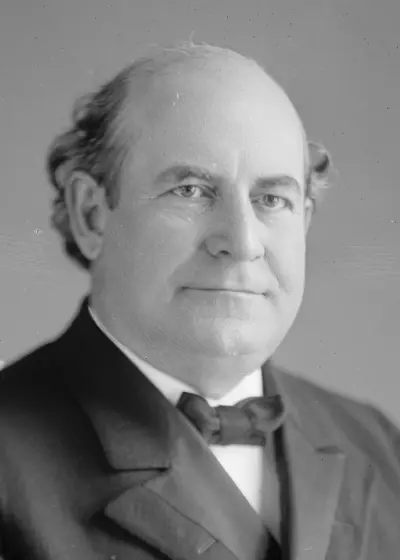
- Born: March 19, 1860
- Died: July 26, 1925
- Nationality: American
- Profession: Lawyer
William Jennings Bryan was an American orator and politician from Illinois and Nebraska. Beginning in 1896, he emerged as a dominant force in the Democratic Party, running three times as the party's nominee for President of the United States in the 1896, 1900, and 1908 elections. He also served in the United States House of Representatives and as the United States Secretary of State under Woodrow Wilson. Because of his faith in the wisdom of the common people, he was often called "The Great Commoner".
