Theodore Roosevelt Quotes
No human beings, black, yellow, or white could be quite as untruthful, as insincere, as arrogant—in short, as untrustworthy in every way—as the Russians.
Theodore Roosevelt, 1858-1919, 26th President of the United States (Republican, NY), Letter to William Woodville, August 29, 1905
Sourced by: Eigen's Political and Historical Quotations


Characterizing Richard Holbrooke, Assistant Secretary of State (Democrat):

Franklin was America’s preeminent diplomat. He was particularly resented by the British authorities because he had achieved so much fame as a “British” scientist and man of letters, had been recognized and decorated by British institutions, was wealthy and very popular in London and all over Europe. Above all, the King could not understand why Franklin was not a loyalist and resented him more than most of the American rebels.

Marshall was one of the greatest soldiers who ever served America. He was the Chief of Staff throughout the Second World War and then served as Secretary of State. It was he who devised and implemented the Marshall Plan. McCarthy accused thousands of people of being disloyal including Marshall. He claimed to have lists of communists in the Army and other agencies of government, but never produced such lists. In addition to being a overbearing demagogue, he suffered (and died from) from a serious case of alcoholism. McCarthy’s false and irresponsible attacks eventually caused the Senate to censure him. That and his drinking destroyed his career. Marshall is remembered as one of America’s great figures.


The attitude of the non-Muslims at that time was based on the Muslim attacks in the Punjab on Sikhs where entire Sikh villages and neighborhoods in towns and cities were murdered—every man woman and child. In many cases women were first raped. The Muslims had been whipped up by the leaders of the Muslim League to put terrorist pressure on the Sikh, Hindu and British to meet the League's political and territorial demands for an Independent Pakistan. Soon there was retaliation in kind and there were many Hindus, Sikhs and Muslims engaged in internecine slaughter and behaving "little better than animals".


He was referring to the people of India and not the American Indians for who he also had little respect like almost any minority.

The Turks had massacred the vast majority of their Armenian population, and treated the Greeks badly killing and them many of them from territories the Ottoman Turks had conquered. Jews fared better but were 2nd class citizens. Bristol was the American State Department’s senior official and was very “understanding” of the murders and ethnic cleansing despite the fact that President Wilson and most American politicians were very opposed to the Turkish massacres. See {620614} and {620599} . Two factors makes this quotation very significant. First, at the time the State Department was not really under the control of either the President or the Congress. It was not rare for the Department to have its own policies and implement them. This began to change in WWII and FDR exercised much more control than previous presidents since Theodore Roosevelt. The second factor is that there were many racists throughout the State Department—Bristol was only one. There was little concern for minorities’ welfare and the emphasis was on commerce. See {620600} Even in Truman’s administration, the President had massive opposition from the State Department for his policy of recognizing the State of Israel. Today, this kind of racism in the State Department is very rare, and human rights has been one of their major concerns. There were many changes in 75 years.

For this and other “insulting” remarks, Burr challenged Hamilton to a duel in 1804 and killed him. However, the result was that Hamilton’s view of Burr was given huge publicity and Burr’s political career died along with Hamilton.

Russia then had designs on Afghani Territory. About a century later, Russia Invaded Afghanistan and tried to impose a communist government. It failed and the Afghans drove out the Russians.

This is a complaint that many nations make against the United States. Few foreigners really understand the United States form of government which differs from the usual Parliamentary form that exists in most of the world. Specifically, in the Parliamentary system, the Government (Executive Branch) and the Legislature are one and the same. Often it includes the judiciary. In America we have separation of powers and these branches not only are not coordinated and consistent but are often at odds with each other. As a result, Presidents and Secretaries of State can make honest commitments and promises but later find that the Congress will block American fulfillment of the promise. At the time, the most glaring example was President Wilson who was so active in advocating a League of Nations and then when it became a reality, the Senate would not ratify the treaty and America could not join, thereby dooming it to failure. There have been many other examples in history. Another dramatic one was President Obama promising to close the prison camp at Guantanamo Bay during the War on Terror, Congress would not appropriate any funds to move the prisoners anywhere else, and the President’s promise to other nations could not be fulfilled. This is a structural part of the American system. Some people see it as a weakness; others, as a strength.
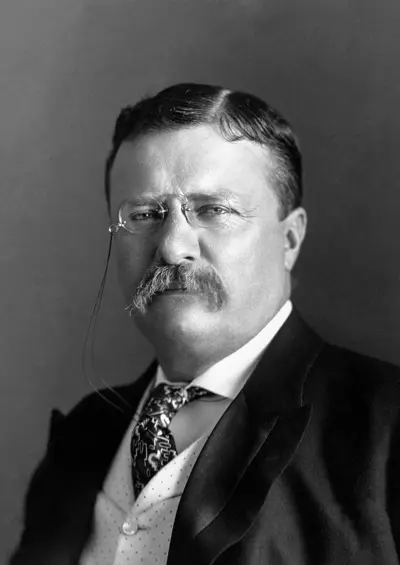
Theodore Roosevelt Jr., often referred to as Teddy or his initials T. R., was an American statesman, conservationist, naturalist, historian, and writer, who served as the 26th president of the United States from 1901 to 1909. He previously served as 33rd governor of New York from 1899 to 1900 and the 25th vice president of the United States from March to September 1901. Roosevelt emerged as a leader of the Republican Party and became a driving force for anti-trust and Progressive policies.
