Enver Hoxha Quotes
No country whatsoever, big or small, can build socialism by taking credits and aid from the bourgeoisie and the revisionists or by integrating its economy into the world system of capitalist economies. Any such linking of the economy of a socialist country with the economy of bourgeois or revisionist countries opens the doors to the actions of the economic laws of capitalism and the degeneration of the socialist order. This is the road of betrayal and the restoration of capitalism, which the revisionist cliques have pursued and are pursuing.
Enver Hoxha, 1908–1985, Communist Prime Minister of Albania, First Secretary of the Party of Labour, Chairman of the Democratic Front of Albania, Report on the Activity of the Central Committee of the Party of Labour of Albania
Sourced by: Eigen's Political and Historical Quotations


Although the Nazis railed against the Communists & Socialists, the potential opposition they feared the most was the middle class. See also {582966}.

The British suspected that the Turks of Anatolia were complicit with Bolshevism

At the Seventh World Congress of the Comintern in 1935 the new Popular Front policy was announced. To communist hard-liners and to the far left, the policy was an abandonment of the Marxist revolutionary line.


The Red Scare had already reached most conservatives and Truman and most others had not yet been affected by the fear of Communism that so many people had through the 1970s.


Tito did not realize how right he was. The class issues were relatively easy to resolve into a unified nation, but the ethnic, national, and religious difference and historical hatreds and conflicts were held together during Tito’s lifetime, as he was a very strong leader committed to multiculturalism and imposed it on all of Yugoslavia. However, when he did in 1980, Yugoslavia rapidly flew apart into ethnocentric independent cultures which then went to war with each other.


This was much less a treaty of how the two nations would interact with each other, than a joint statement to the world of opposition to any nation interfering with the internal affairs of another country.


This became known as the Brezhnev Doctrine.
After WWII the United States provided food aid to much of Western Europe and offered it to some of the Eastern European Russian dominated countries as well. Russia would not allow them to accept American aid, but Tito of Yugoslavia was very independent and although his nation was socialist, he exported manufactured goods to the West and was happy to accept American aid. During the Cold War, Yugoslavia was doing business with America and other Western nations. A large proportion of all the school desks in America were manufactured in Yugoslavia much the distress of the Russians.


Most classic socialists would not agree, but Deng’s approach created the most economically successful socialist economy in history.

This quotation illustrates the statements of White that caused conservatives to dislike him. However, most historians agree that White passed classified information to the Russians. He was accused of being a Communist, but there was never any evidence of that. Some people believe that he was a spy for the Russians and committed espionage, but others disagree observing that White was very much his own man and felt that much information that was classified never should have been. White substituted his own judgment, it is believed, about what could be given to the Russians for the security system. He was an admirer of what Russian socialism had accomplished economically, educationally and medically since the 1917 revolution deposing the Czar. Russia had been a valuable military ally, which had taken the brunt of both military and civilian casualties in WWII. White’s economics were certainly not Marxist but very much Keynesian. He was subpoenaed by the House Un-American Activities Committee where he was accused of being a Communist which he denied (see {634907}). He died of a heart attack 3 days later.
This quotation illustrates White’s favorable view of Russia. Note his use of the “it works” phrase which he picked up from Stefens’ famous quote {634892}. At the time the Soviet Union had been perceived by many economists to have been a great economic improvement over Czarist Russia. And over all, Russia which in 1917 was an economic basket case, had become one of the stronger states in Europe although the Russian people paid a horrendous price. Most historians agree that White passed classified information to the Russians. He was accused of being a Communist, but there was never any evidence of that. Some people believe that he was a spy for the Russians and committed espionage, but others disagree observing that White was very much his own man and felt that much information that was classified never should have been. White substituted his own judgment, it is believed, about what could be given to the Russians for the security system. He was an admirer of what Russian socialism had accomplished economically, educationally and medically since the 1917 revolution deposing the Czar. Russia had been a valuable military ally, which had taken the brunt of both military and civilian casualties in WWII. White’s economics were certainly not Marxist but very much Keynesian. He was subpoenaed by the House Un-American Activities Committee where he was accused of being a Communist which he denied (see {634907}). He died of a heart attack 3 days later.

Vladimir Lenin

Cuba was not Communist under Castro in the Russian style of Communism. However, Castro operated Cuba with many of the key Marxist & Leninist Communist Principles {636672} (some of which the Russians were hypocritical about). Cuba was very much a Marxist, Socialistic State with few of the democratic reforms that characterized European Socialism. Until the collapse of the Soviet Union, Russian Communist aid propped up the Cuban economy, and that was another motivation for Castro not to criticize Russian Communism so he often appeared to be in agreement with Russian Communism even when he wasn't.

At the time, this was not popular with many socialists who had given up on the lack of fairness and equity of the capitalistic system. A century later, most politicians and political philosophers had given up on socialism ever meeting Bauer’s test, and Capitalism was well ensconced in Western Democracies.

This is an example of what made the Cold War so difficult. The Italian Communists had great misgivings about the Russian version of Communism that tended to abuse human rights and try and control other countries. However, when the Russian Communists were under world attacks by the West, as with their incursion into Hungary, he urged that all the Communists stick together and defend the Russians even for policies that they thought wrong. On the West side, the same thing occurred. The United States tolerated and supported a number of terribly oppressive dictatorships that were virulently anti-Communist. Polarization was the international norm.
Immediately after the Russian Revolution, the provisional government appointed him as Ambassador to the United States. However, the provisional government was supplanted when the Bolsheviks took over. Not enamored of Communism, he stayed in the United States with many other Russian refugees.

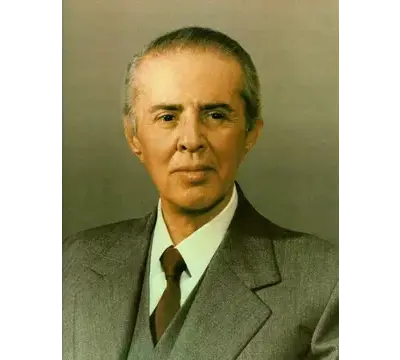
Enver Hoxha was an Albanian communist revolutionary and statesman who served as the First Secretary of the Party of Labour of Albania, from 1941 until his death in 1985. He was also a member of the Politburo of the Party of Labour of Albania, chairman of the Democratic Front of Albania, commander-in-chief of the armed forces from 1944 until his death. He served as the 22nd Prime Minister of Albania from 1944 to 1954 and at various times served as foreign minister and defence minister of the People's Socialist Republic of Albania as well.
