Ayn Rand Quotes
I consider the Birch Society futile, because they are not for capitalism but merely against communism ... I gather they believe that the disastrous state of today's world is caused by a communist conspiracy. This is childishly naive and superficial. No country can be destroyed by a mere conspiracy, it can be destroyed only by ideas.
Ayn Rand, 1905-1982, Writer & Philosopher, Playboy interview, 1964
Sourced by: Eigen's Political and Historical Quotations

Bunch was the undersecretary-general of the United Nations who won the Nobel Peace Prize for his mediation efforts in the Middle East. Archie Roosevelt and his extreme right wing associates thought that anyone who worked in the UN was a communist and had no respect for the Norwegian Nobel Prize Committee. In the spirit of Archie Roosevelt’s father, the Theodore Roosevelt made the award to Buche and ignored Archie’s slanderous attack. Surprising to most people who know of President Theodore Roosevelt’s general liberal views, his 4th son was an ultraconservative who founded and joined racist, anti-Semitic, right wing organizations, and to the distress of many in the family and without lent his name to many of the most extreme right wing causes and organizations.


He was convicted of various felonies including threatening federal officials and sentenced to prison.


The Red Scare had already reached most conservatives and Truman and most others had not yet been affected by the fear of Communism that so many people had through the 1970s.
The Red Scare had already reached most conservatives and Truman and most others had not yet been affected by the fear of Communism that so many people had through the 1970s.

Even the President was not spared during the McCarthy era. The red scare was so pervasive, that a lunatic fringe ultra right wing organization could call the President a “communist dupe” and be taken seriously be much of the media who were themselves intimidated and might be accused of being communists at any moment. It was a very low point in America’s history.


Yale University had announced the discovery of a Norse map called the Vinland Map. It was an old Viking map that showed the East Coast of America and Canada as well as Greenland and Iceland. It purported to prove that the Vikings had been to America before Columbus. This was shocking and unbelievable to large numbers of Italian Americans many of whom lived in New York City. Most Italian Americans rejected the possibility that the map could be genuine, but there had to be a reason that it was forged. In the midst of the Cold War, there was an obvious villain and it did not take long before large numbers of people believed and repeated the headline. The quotation shows how rabid the anti-Communism of the Cold War was. The authenticity of the Vinland Map is still debated. Ironically, Columbus—the “discoverer” of America, never got to North America at all. He landed in and captured some islands in the Caribbean. The Daily News was then the largest circulation newspaper in the United States.

This quotation was obtained via an FBI wiretap on Dr. King’s telephone. What makes it historically important is that J. Edgar Hoover’s FBI steadfastly maintained that King and his movement were philosophically communist in their reports to the President and others. For example, a CIA memo of the time reported that “According to the FBI, Dr. King is regarded in Communist circles as a genuine Marxist-Leninist who is following the Marxist-Leninist Line.” However, Hoover had this and other evidence of King’s antipathy to communism but suppressed this leading the administration and others to believe that the Civil Rights Movement, to which Hoover was unalterably opposed, was Communist influenced. See {603873}, {603891}, {603872}, and {603889} showing Hoover’s view of King and Blacks.
This quotation illustrates the derogatory and disrespectful attitude that many high level American officials then had towards Arab leaders. No one objected to or reprimanded Symmes for his use of the word “mongrels”. And he was the State Departments leading expert on the Middle East and Arab Cultures. In the photo, Symmes is the gentlemen on the right.

The president was surprised by the rapid spread and expansion of the anti-war movement at the time was convinced that the communists were organizing the effort. After all the investigations and histories, it was an extremely fast growing movement—perhaps the first of the digital political movements as e-mail was one of the tools used in the universities where e-mail was then coming into use.


This quotation illustrates the statements of White that caused conservatives to dislike him. However, most historians agree that White passed classified information to the Russians. He was accused of being a Communist, but there was never any evidence of that. Some people believe that he was a spy for the Russians and committed espionage, but others disagree observing that White was very much his own man and felt that much information that was classified never should have been. White substituted his own judgment, it is believed, about what could be given to the Russians for the security system. He was an admirer of what Russian socialism had accomplished economically, educationally and medically since the 1917 revolution deposing the Czar. Russia had been a valuable military ally, which had taken the brunt of both military and civilian casualties in WWII. White’s economics were certainly not Marxist but very much Keynesian. He was subpoenaed by the House Un-American Activities Committee where he was accused of being a Communist which he denied (see {634907}). He died of a heart attack 3 days later.

Romania had a mediocre small arms manufactureing capability but their weapons were not in great demand by governments around the world. However, there were illegal insurgent groups in many countries who would pay hard currency for arms that would b smuggled into various countries. Governments like Romania were not supposed to sell to these groups, but Romania did.


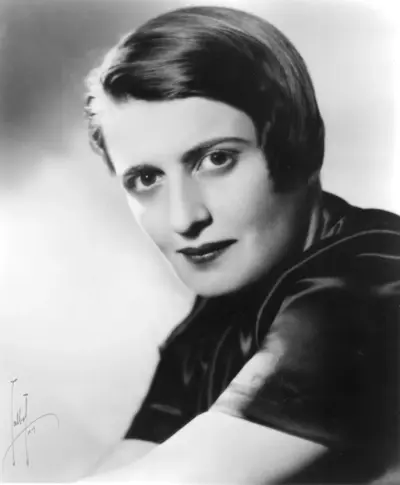
Ayn Rand was a Russian-American writer and philosopher. She is known for her two best-selling novels, The Fountainhead and Atlas Shrugged, and for developing a philosophical system she named Objectivism. Born and educated in Russia, she moved to the United States in 1926. She had a play produced on Broadway in 1935 and 1936. After two early novels that were initially unsuccessful, she achieved fame with her 1943 novel, The Fountainhead. In 1957, Rand published her best-known work, the novel Atlas Shrugged. Afterward, she turned to non-fiction to promote her philosophy, publishing her own periodicals and releasing several collections of essays until her death in 1982.
